How to Choose a Travel Voltage Converter for Japan
Most US travelers need a step-down converter for single-voltage 110V appliances in Japan. Check the appliance label, wattage and plug shape before choosing between a converter, an adapter or both.
On this page (7 sections)
- Do you need a travel voltage converter for Japan?
- What should you check before choosing a travel voltage converter for Japan?
- Which travel voltage converter for Japan fits your setup?
- Which converter features matter for Japan travel?
- How should you use a travel voltage converter in Japan?
- What should you pack with the converter?
- Which travel voltage converter for Japan should you choose?
Most US travelers need a step-down travel voltage converter for Japan when they want to use a single-voltage 110V appliance. Start with the label on that appliance, then match its voltage, wattage and plug needs to the converter you plan to carry.
Japan uses about 100V power, while the frequency is 50Hz in some regions and 60Hz in others. That mix matters for appliances that rely on frequency for motors, clocks or heating, so voltage alone is not the whole check.
Many phone, tablet and laptop chargers accept a wide input range, so they may need only a plug adapter. A converter becomes more relevant for a US-only heating tool or a device that clearly states a single 110V or 120V input.
Think about what you actually use each day on a trip before adding weight to your case. A step-down converter suits the person packing one specific appliance that already works well at home, not the person who can easily use a dual-voltage replacement.
It also suits travelers who prefer to bring a familiar tool rather than buy a new one for a short stay. The trade-off is extra bulk, another cable and a setup step that a simple plug adapter avoids.
If your charger already lists 100-240V and 50/60Hz, a converter may be unnecessary for that device. Keep a short list of each item's requirements so the choice stays clear when you pack.
Do you need a travel voltage converter for Japan?
You need a converter when your appliance accepts only 110V or 120V and the local power does not match its required input. You may not need one for a charger marked 100-240V, 50/60Hz, because that range is designed for different electrical systems.
Check the small label on the charger or appliance before you buy anything. Look for:
- Input voltage, such as 110V, 120V or 100-240V
- Frequency, such as 50Hz, 60Hz or 50/60Hz
- Wattage, shown as W
- Plug shape and grounding needs
A plug adapter changes the physical connection only. Our guide to travel adapter vs voltage converter explains why the two devices solve different problems.
The label is more reliable than the shape of the plug or the country where the appliance was sold. A US plug does not prove the device needs conversion, and a small size does not prove it uses little power.
Your appliance's wattage must stay within the converter's limit. Heating products such as hair dryers, curling irons and flat irons need extra care because they can draw much more power than a phone charger.
Frequency can also affect how some appliances run, even when the voltage range looks close. If the appliance manual warns about frequency or motor speed, treat that as part of the decision and not a minor detail.
Dual-voltage devices are usually the simplest option for travel. A single-voltage device can still travel well, but it asks for a converter and a more careful check of the wattage before each use.
Packing a converter for one appliance does not mean every device in your bag needs it. Separate the chargers that accept a wide range from the tools that need step-down power, then pack only what the trip requires.
What should you check before choosing a travel voltage converter for Japan?
Choose by appliance voltage, wattage and plug type, then decide whether you need USB charging or several outlets. The converter should meet or exceed the appliance's power demand without being used beyond its stated limit.
Is the appliance dual voltage?
A dual-voltage appliance may show 100-240V, 50/60Hz. If yours has that marking, it can often work with a suitable plug adapter, but you still need to confirm the manufacturer's instructions.
A single-voltage 110V appliance needs a step-down converter for a different electrical supply. Some appliances also depend on frequency, so a voltage match alone does not guarantee identical operation.
How much wattage does the appliance use?
Find the wattage printed on the appliance. Compare it with the converter's maximum output, and leave a sensible margin instead of choosing a unit that operates at its limit.
Never judge suitability by physical size. A compact charger may use little power, while a heating tool can require far more.
Do you need conversion, plug adaptation or both?
You may need both functions. The converter changes electrical voltage, while the adapter lets the appliance plug fit the wall outlet.
The travel charger complete buying guide can help if your main goal is charging phones, watches, tablets or other small electronics. For a converter and adapter combination, check how the included plugs match your destination and device.
Which travel voltage converter for Japan fits your setup?
The best choice depends on whether you need true voltage conversion, a universal plug system or both. These 3 options cover different travel setups, but none should be treated as suitable for every appliance.
FOVAL Power Step Down 220V to 110V
FOVAL suits travelers who need a 230W step-down converter with multiple charging connections. It has 2 AC outlets, 4 USB charging ports, a detachable 5 ft power cable and a compact 4.82 x 3.13 x 1.47 in body.
It steps down 220V to 110V and includes an EU power cable plus international adapters for US, UK, AU and China plug types. Its USB output is 5V with 8.4A total, and each USB port supports up to 2.4A.
FOVAL lists protection against surges, overheating, short circuits, over-current, over-temperature and overload, with automatic shutdown. It is designed for appliances under 230W, and its warm-use guidance excludes hair dryers and electric heaters.
Choose it for a straightener, curling iron, electric toothbrush or other appliance that fits the watt limit. For more detail on one common use, see our guide to a travel voltage converter for a flat iron.
EPICKA Universal Travel Adapter with 1AC/3 USB-C/2
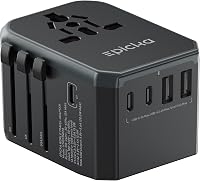
EPICKA suits travelers who mainly need plug adaptation and multi-device charging, not voltage conversion. It has 1 AC socket, 3 USB-C ports and 2 USB-A ports, with support for charging up to 6 devices at the same time.
The adapter includes plug types for the EU, US, UK and Australia and covers more than 200 countries and regions, excluding South Africa and India. Its USB-A ports support 2.4A, while the USB-C ports support 3A.
EPICKA clearly states that this is not a voltage converter. It also has a replaceable 10A fuse, one spare fuse, safety shutters and a plug lock system.
Choose it for phones, laptops, tablets, cameras and similar devices that accept the local voltage. It is not the right choice for a single-voltage hair dryer, curling iron or straightener.
BESTEK Universal Travel Adapter 220V to 110V
BESTEK suits travelers who want step-down conversion plus several AC and USB connections. It converts 100-240V input to 110V output, supports up to 250W and has 3 AC outlets, 2 USB-A ports and 2 USB-C ports.
Its USB-C ports support PD 20W charging, and the unit can power or charge up to 7 devices at once. The included plug adapters cover EU, UK, AU, US and India types, including the Type A connection commonly used in Japan.
BESTEK specifically excludes hair dryers, coffee machines, steam irons, kettles and juicers, regardless of wattage. It supports curling irons and straighteners, but avoid tools that accept only one voltage input without checking their requirements.
Choose it when you need more outlets than the FOVAL provides and can stay within the 250W limit. If you want to compare a converter designed around a 110V-to-220V direction, read our 110V to 220V travel voltage converter guide.
Which converter features matter for Japan travel?
The most useful features are a correct output voltage, enough wattage, the right plug connection and protection that matches your use. Extra USB ports help only when your devices already support the adapter's charging output.
Step-down output
A step-down converter changes higher input voltage to a lower output voltage. The FOVAL and BESTEK products here are designed to provide 110V output, but you still need to compare that output with your appliance label.
Outlet and USB count
Count the devices you expect to use at the same time. FOVAL offers 2 AC outlets and 4 USB ports, BESTEK offers 3 AC outlets and 4 USB ports, and EPICKA offers 1 AC socket with 5 USB ports.
More ports can reduce the number of chargers in your bag. They do not increase the converter's safe wattage limit.
Protection and reset features
FOVAL lists automatic shutdown for several fault conditions. BESTEK lists over-current, overload, overheat and short-circuit protection.
EPICKA uses a replaceable 10A fuse that is designed to cut power when total current exceeds 10A.
These features help manage electrical faults, but they do not make an unsuitable appliance safe to connect. Stay within the stated limits and stop using a device that becomes unusually hot or behaves unexpectedly.
Protection matters most when you are using a converter in an unfamiliar room. A hotel outlet may be shared or older, so a shutdown or blown fuse can be a useful warning rather than a fault to ignore.
Think about reset steps before you travel. FOVAL and BESTEK rely on built in protection, while EPICKA asks you to replace the fuse with the spare included in the box.
That difference suits different routines. If you prefer automatic shutdown, the converter options may feel simpler to pack and check each day.
If you are comfortable opening the fuse compartment, the EPICKA setup is clear as long as you use the correct 10A replacement. Keep the spare with the adapter so the repair does not become a search through your luggage.
How should you use a travel voltage converter in Japan?
Set up the converter on a dry, open surface, connect the correct plug adapter and check the appliance wattage before switching it on. Do not cover the converter or place it where heat can build up.
Use this order:
- Read the appliance input voltage, frequency and wattage.
- Confirm whether the appliance is single-voltage or dual-voltage.
- Check that the converter supports the appliance type and wattage.
- Attach the plug adapter needed for the Japanese outlet.
- Connect the converter to the wall before connecting the appliance.
- Watch for heat, noise or an unexpected shutdown.
- Disconnect the appliance before packing the converter.
Let the converter sit where air can move around it during use. A hotel desk or bedside table usually works better than a closed cabinet or a pile of clothes.
Plug the converter into the wall first, then connect the appliance, so you can notice any shutdown or unusual sound before the device starts heating. This order also makes it easier to disconnect safely.
Keep cords dry and avoid forcing a plug into an outlet. A plug that does not fit usually needs a different adapter, not more pressure.
Watch the first few minutes of use more closely than later use. Heat, odor, buzzing or a sudden stop are reasons to switch off and recheck voltage, wattage and appliance type.
If you are mainly charging Apple devices, our guide to the best travel charger for iPhone and Apple Watch covers a different type of travel-power setup.
What should you pack with the converter?
Pack the converter, its required cable or plug adapters, the appliance cord and a short note of each device's voltage and wattage. This prevents guesswork when several chargers look similar.
A small cable pouch can keep adapters from separating from the converter. If you are also visiting another country, compare its outlet needs before packing a separate travel power strip for Italy.
Do not pack a converter just because an appliance has a US plug. First check whether that appliance already accepts 100-240V, 50/60Hz.
A universal adapter may be enough for that device.
Write the voltage and wattage note before you leave home, while the labels are easy to read. A photo of each label on your phone can serve the same purpose if you prefer a digital copy.
Keep the converter cord and plug adapters together so you are not searching a hotel room for a missing piece. Loose adapters tend to drift to the bottom of a case and get left behind.
Consider how often you will use the appliance and whether a dual-voltage option would lighten your load. A converter makes sense for a tool you use daily, but it can be extra bulk for a device you may never switch on.
Leave room in your packing plan for safe storage after use. A hot appliance and its converter should cool down before they go back beside clothing and cables.
Which travel voltage converter for Japan should you choose?
Pick FOVAL if your appliance is under 230W and you want a compact unit with 2 AC outlets, 4 USB ports and international adapters. Pick BESTEK if you need up to 250W, 3 AC outlets and 7 total device connections.
Pick EPICKA for multi-device charging when your electronics already accept the local voltage. It is an adapter, not a converter, so it should not be your choice for a single-voltage appliance that needs voltage reduction.
For hair dryers, check the dedicated guide to the best travel voltage converter for a hair dryer before connecting anything. The key rule is simple: match the appliance's voltage and wattage first, then choose the plug and port layout that fits your trip.
Start with the appliance you care about most. If that item is a straightener, curling iron or another under limit heating tool, a step down converter can keep your usual routine familiar.
If the item is a phone, tablet or laptop charger marked for a wide voltage range, an adapter only option may be lighter and simpler.
Consider how many devices you will charge at the same time. FOVAL gives you 2 AC outlets with 4 USB ports, while BESTEK gives you 3 AC outlets with 2 USB A ports and 2 USB C ports.
EPICKA gives you 1 AC socket with 3 USB C ports and 2 USB A ports, which suits a group charging phones and small electronics.
Packing size also matters for a long trip. FOVAL lists a compact 4.82 x 3.13 x 1.47 in body with a detachable 5 ft cable, and BESTEK lists a 6.18 x 3.15 x 1.38 in body.
EPICKA lists a 2.9 x 2.07 x 2.15 in body, so it may fit more easily into a small pouch.
Check the plug types included before you choose. FOVAL includes an EU power cable plus US, UK, AU and China adapters, and BESTEK includes an EU power cable plus UK, US, India and AU adapters.
EPICKA includes plug types for EU, US, UK and Australia, and it does not cover South Africa or India.
Read the exclusion list as carefully as the watt limit. FOVAL excludes hair dryers and electric heaters, and BESTEK excludes hair dryers, coffee machines, steam irons, kettles and juicers regardless of wattage.
EPICKA warns that it is not a voltage converter and may not suit high power appliances such as hair dryers, curling irons and straighteners.
Care for whichever option you choose starts with dry, open placement during use. Keep cords untangled, avoid covering the unit, and let it cool before packing it beside clothing and cables.
If you use EPICKA, also keep its spare 10A fuse with the adapter and replace a blown fuse before reuse.
For most travelers, the right pick is the one that matches the label already on the appliance. Dual voltage electronics point toward EPICKA, while a single voltage tool within the stated limit points toward FOVAL or BESTEK.
Frequently asked questions
Do I need a voltage converter for Japan?
You need a voltage converter in Japan when your appliance is designed only for 110V or 120V and cannot accept Japan's electrical supply. Check the label first.
Appliances marked 100-240V, 50/60Hz usually need only a plug adapter, while single-voltage heating appliances may need a step-down converter.
Is Japan 110V or 220V?
Japan uses about 100V power, with 50Hz or 60Hz frequency depending on the region. A US appliance marked 110V or 120V may still need careful checking because the voltage and frequency do not match exactly.
Follow the appliance and converter instructions before use.
Can I use a travel adapter instead of a voltage converter in Japan?
A travel adapter changes the plug shape but does not change voltage. Use an adapter alone only when the appliance accepts the local voltage, such as many chargers marked 100-240V, 50/60Hz.
A single-voltage appliance needs voltage conversion as well as the correct plug connection.
Can I use a hair dryer with a Japan voltage converter?
Do not assume a converter can run a hair dryer. Hair dryers use high power, and the FOVAL and BESTEK products here specifically exclude hair dryers.
Check the converter's watt limit and appliance instructions, or use a dual-voltage dryer designed for international travel.