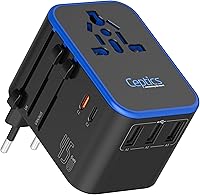
How to Choose a Travel Power Strip for Italy
The best travel power strip for Italy depends on your device voltage and charging needs: choose a plug adapter for dual-voltage electronics, or a voltage converter for compatible devices that need 110V input. Check watt limits before packing hair tools or other high-power appliances.
On this page (7 sections)
- What should you check in a travel power strip for Italy?
- Do you need a plug adapter or a voltage converter?
- Which product fits a US travel setup?
- How many ports do you need for an Italy trip?
- How should you pack and use a travel power strip?
- What else can help you charge on the move?
- Final decision for a travel power strip for Italy
The best travel power strip for Italy depends on your device voltage and charging needs. Choose a plug adapter for dual-voltage electronics, or a voltage converter for compatible devices that require 110V input.
Italy uses a different plug shape and a higher supply voltage than the United States. That simple difference is why a charger that works at home may need help before it can be used safely in a hotel room, rental apartment or guesthouse there.
Most travelers should start by checking the label on every charger. If it says 100-240V, 50/60Hz, you usually need the correct plug shape, not voltage conversion.
That label tells you the range of voltages the charger can accept. A wide range means it can handle both US and Italian supplies without a converter, while a single voltage means you need to think more carefully before plugging it in.
Check the small print on the charger itself rather than guessing. Phone, tablet and laptop chargers often support a wide range, but older or specialized devices may not, so the label is the safest guide.
For a broader overview of ports, adapters and charging plans, read our travel charger guide. It can help you build a setup before you decide how many outlets and USB ports you need.
That planning step matters because Italy trips vary a lot. Some travelers only need to charge a phone overnight, while others carry a laptop, camera, watch and earbuds and want them all ready by morning.
Sorting devices now can prevent a crowded outlet later. You can decide which items need a wall socket, which can use USB, and which are better charged from a power bank during the day.
What should you check in a travel power strip for Italy?
Check plug fit, voltage, wattage and port count in that order. A strip that charges several phones is not automatically suitable for a heating tool or another high-power appliance.
Italy uses European-style outlets, so the travel power strip or adapter must fit the outlet you expect to use. A universal adapter can cover more plug shapes, but it still does not change the electricity supplied by the wall.
Next, separate your devices into 2 groups:
- Dual-voltage chargers, such as many phone, tablet and laptop chargers.
- Single-voltage or high-power devices, such as some hair tools.
Dual-voltage chargers usually work with a plug adapter when their input label includes 100-240V. A single-voltage device that needs 110V requires a suitable converter, and the converter must support its wattage.
For more port-focused comparisons, see our guide to the best travel power strips with USB ports.
Do you need a plug adapter or a voltage converter?
You need a plug adapter when the plug shape is the problem. You need a voltage converter when the device requires a different input voltage and is compatible with the converter's limits.
An adapter has a simple job: it lets your device plug into a different outlet shape. It does not lower or raise voltage, so it cannot make a 110V-only appliance safe on a 220-240V supply.
That distinction is easy to miss when shopping, because both items look like travel accessories. The difference is what they do to the electricity, not just how the plug fits in the wall.
A converter changes voltage, but it adds limits and weight. Read the device label, identify its wattage, and compare that number with the converter's maximum output before packing.
Wattage matters because a converter can only handle a set amount of power. If a device draws more than that limit, the converter may shut down or be unable to run it properly.
A dual-voltage device may have a switch marked 110V and 220V. Set it correctly before use if the device requires manual selection.
That switch must be set before you connect the device to power. Leaving it on the wrong setting can prevent the device from working as intended, even when the plug shape is correct.
A charger marked 100-240V normally handles the range automatically. You do not need a converter for that type of charger, and adding one would only make your setup heavier and less convenient.
Hair tools and heating appliances deserve extra care. Many of them are high-power devices, so check both voltage and wattage before assuming an adapter or converter will be suitable.
Which product fits a US travel setup?
These 3 products solve different problems. The FOVAL is for step-down voltage conversion, the EPICKA is for plug adaptation and multi-device charging, and the BLAVOR is a backup power source for outdoor or outage situations.
FOVAL Power Step Down 220V to 110V
The FOVAL suits travelers bringing compatible 110V electronics that need voltage reduced from 220V to 110V. Its 230W limit makes it a poor match for hair dryers and electric heaters, even though it is designed for some lower-power hair tools and personal electronics.
It measures 4.82 x 3.13 x 1.47 in and has a 5 ft detachable power cable. The 4 USB ports provide up to 2.4A per port, with 8.4A total USB output.
The converter includes a Type C plug and adapters for US, UK and Australian plug types. It accepts 100-240V, 50/60Hz input and provides 110V output.
Use its 2 AC outlets for compatible devices that need the converted voltage. The 4 USB ports can charge smaller devices at the same time, but the total load still needs to stay within the converter's limits.
The FOVAL has automatic shutdown protection for surge, overheating, short circuit, over-current and overload conditions. It is certified to CE, FCC and RoHS standards, and its white case weighs 0.5 kg.
Choose it when voltage conversion is the main need. Skip it when all your chargers already support 100-240V, because a smaller plug adapter may be easier to pack.
EPICKA Universal Travel Adapter with 1AC/3 USB-C/2 USB-A Ports
The EPICKA suits travelers who need one compact adapter for several devices that already support the local voltage. It has 1 AC socket, 3 USB-C ports and 2 USB-A ports, so you can charge up to 6 devices at once.
Its 2.9 x 2.07 x 2.15 in body weighs 5.1 oz. The plug types cover Type C, Type G, Type I and Type A outlets, and the adapter includes a replaceable 10A fuse plus 1 spare fuse.
The 2 USB-A ports provide 2.4A, while the 3 USB-C ports provide 3A. Its maximum power is 1,100W at 110V and 2,400W at 240V.
EPICKA states that this adapter does not convert voltage. Do not use its AC socket for a 110V-only hair dryer, curling iron or straightener on a 220-240V supply.
The adapter includes 1 travel adapter and 1 user manual. It has safety shutters, a plug lock system and RoHS, CE and FCC compliance.
Choose it for phones, tablets, cameras, laptops and other dual-voltage devices. If you need more help comparing adapter and strip designs, see our best travel adapter power strip guide.
BLAVOR Solar Power Bank
The BLAVOR suits travelers who want a portable backup for USB-charging devices away from an outlet. Its 10,000mAh capacity, wireless charging and built-in cables can reduce the need to find a wall socket during a day outside.
The BLAVOR measures 5.91 x 3.07 x 0.87 in and weighs 9.3 oz. It supports USB-A, USB-C and iOS connectors, and it can charge up to 3 devices at the same time.
Its USB-C output supports 20W fast charging. The power bank also supports 10W wireless charging for compatible devices.
BLAVOR says the battery can charge an iPhone 8 up to 3.6 times, an iPhone 14 Pro up to 2.2 times and an iPad Air once when fully charged. Actual results depend on the device and charging conditions.
The solar panel is best treated as an emergency backup. Its maximum charging current is 0.23A, with maximum solar power of 1.15W, so cable charging is the practical primary method.
The outer case uses flame-retardant ABS and PC materials with waterproof silicone protection. The unit includes a compass carabiner, solar power bank, user manual and built-in cables.
Choose it when you need backup power away from your hotel room. It does not replace a plug adapter or voltage converter for wall charging.
How many ports do you need for an Italy trip?
Choose 4 to 6 charging connections if you plan to charge several personal devices in one room. Count the devices you use at night, then add one spare connection for a camera battery, power bank or travel companion.
That range works for many travelers because it covers the usual mix of personal electronics without adding bulk. Fewer ports may force you to take turns charging, while many more ports can make the setup larger than you need.
A simple setup may include:
- Phone
- Watch
- Earbuds
- Camera battery
- Laptop
- Power bank
Not every traveler carries all six items, and that is fine. The list is a starting point for counting what you actually use each day, rather than a strict checklist.
USB-C ports are useful for newer cables, while USB-A ports can support older charging cables. Having both types can save you from carrying adapters for cables you already own.
An AC outlet gives you room for a separate charger, but it does not turn that charger into a voltage converter. You still need to check the charger's voltage label before using that outlet in Italy.
Think about where you will charge as well as what you will charge. A shared room, a small bedside table or a single convenient outlet can all change how useful extra ports will be.
A compact design helps when luggage space is tight. Compare size, cable length and port layout before choosing.
Port layout affects daily use more than it might seem. Ports on the top can be easier to reach, while ports on the side may suit a narrow space behind furniture.
Our guide to the best compact travel power strip focuses on packing space and everyday access.
Use that kind of comparison to match the strip to your bag and your routine. A well-placed port you reach every night is more useful than an extra port hidden at the back.
How should you pack and use a travel power strip?
Pack the adapter or converter where you can reach it quickly, then keep the cables together with a small organizer. Mark chargers that support 100-240V so you can identify them without checking every label again.
Before plugging in:
- Read the input voltage on the device or charger.
- Confirm whether it needs a plug adapter or voltage conversion.
- Check the device wattage against the converter limit.
- Set any manual voltage switch before connecting power.
- Connect the adapter or converter to the wall first.
- Add devices one at a time.
- Stop if the unit becomes unusually hot, shuts down or shows damage.
Do not cover a converter while it is operating. Keep vents clear, avoid wet areas and unplug it before packing.
For a cruise itinerary that may include different cabin outlets, see our guide to a travel power strip for a cruise ship. A hotel room in Italy and a cruise cabin can have very different outlet rules.
What else can help you charge on the move?
A wall adapter handles hotel charging, while a power bank handles time away from outlets. A charging station can reduce cable clutter when several devices share one room.
Those tools work best when they have different jobs. The wall setup is for overnight charging, the power bank is for the day, and the station is for keeping several cables tidy in one place.
That split can make an Italy trip feel simpler. You do not need every device plugged into the wall all day if a charged power bank can cover a phone while you are out sightseeing.
Our guide to the best travel charging station may suit travelers who charge several devices from one organized setup. If you prefer cable-free phone charging, compare a best travel wireless charger option before packing.
A charging station tends to suit people who like order. It gives each device a set place, which can help when a roommate, partner or child is also charging nearby.
Wireless charging suits a different kind of traveler. It reduces cable fuss for compatible phones, but it still depends on having power available to charge the wireless pad or dock itself.
A slim magnetic power bank can be useful for compatible phones during walking days. See our best slim MagSafe power bank guide if low-bulk backup power matters.
Low bulk matters when you plan long days on foot. A slim backup can stay in a pocket or small day bag without adding much weight to a busy itinerary.
Keep cables and chargers paired where you can. Storing a cable with its device makes it easier to grab the right setup for a train ride, museum day or evening walk.
Final decision for a travel power strip for Italy
Choose the EPICKA if your phones, laptop and other chargers support 100-240V and you mainly need plug fit plus multiple ports. Choose the FOVAL only when you have a compatible 110V device under its 230W limit that needs step-down conversion.
That choice comes down to the devices you actually carry. If most of your chargers already support the Italian voltage range, a plug adapter with enough ports will usually be the simpler option.
If you have a compatible 110V device that needs conversion, check its wattage carefully. Staying under the converter limit is essential, and devices outside that limit should not be assumed to work.
Choose the BLAVOR as an outdoor backup, not as a replacement for wall power. It suits days away from your room, but it does not change plug shapes or convert voltage for wall charging.
The key rule is simple: confirm voltage first, compare wattage second, then choose the smallest setup that covers your devices.
Pack that setup where you can reach it quickly, and keep cables grouped by device. A calm charging routine at night makes mornings in Italy much easier.
Frequently asked questions
Do I need a voltage converter in Italy?
You need a voltage converter only for compatible devices that require 110V input and do not support 100-240V. Many phone, tablet and laptop chargers accept 100-240V, so they generally need a plug adapter rather than voltage conversion.
Check each charger label before connecting it.
What plug adapter do I need for Italy?
Choose an adapter that fits the Italian outlet and matches your device plug. A universal adapter with Type C support can help with common US electronics, but an adapter changes the plug shape only.
It does not convert Italy's voltage.
Can I use a travel power strip with a hair dryer in Italy?
Only use a hair dryer in Italy if it supports the local voltage or you have a converter rated for its power draw. The EPICKA adapter is not a voltage converter, while the FOVAL converter is limited to under 230W and should not power hair dryers or electric heaters.
How many devices should a travel power strip charge?
Count your nightly devices first, such as phones, watches, earbuds, cameras and a laptop. Then compare the number and type of ports.
USB-A and USB-C ports are useful for direct charging, while an AC outlet is needed for a separate charger or appliance.