Travel Adapter vs Voltage Converter: Which Do You Need? (November 2026)
A travel adapter changes plug shape; a voltage converter changes electrical voltage. Check your device label and your destination’s outlet before choosing, since some devices need only an adapter and others need a converter.
On this page (7 sections)
- Travel adapter vs voltage converter: what changes?
- How do you tell whether a device needs conversion?
- Why can a hair dryer be a special case?
- When is a plug adapter enough?
- When do you need a voltage converter?
- Does a travel adapter also protect against surges?
- How should you choose between these travel power options?
A travel adapter changes plug shape; a voltage converter changes electrical voltage. For the travel adapter vs voltage converter choice, check the device label first, then match the gear to the destination’s outlet and power supply.
If a charger says 100–240V, it can generally handle a range of supply voltages, so you may need only a plug adapter for the destination. If a device supports only 110V and the destination supplies 220–240V, a compatible step-down converter may be needed.
A plug adapter cannot make a single-voltage appliance safe to use abroad. For broader travel power basics, see our travel charger guide.
 Best for dual-voltage devices in Europe
TESSAN European Travel Plug Adapter 2 Pack
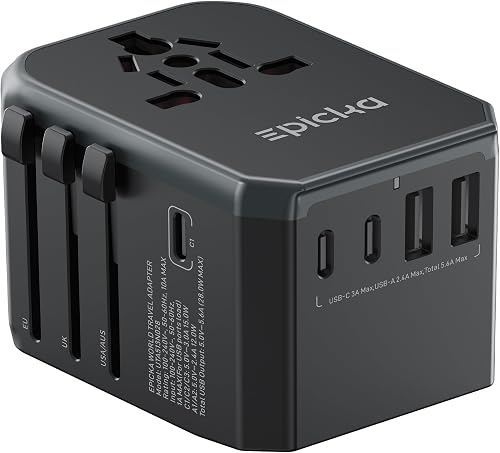 Best for multiple plug regions
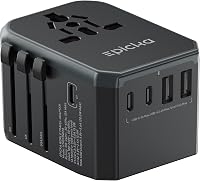
EPICKA Universal Travel Adapter with 1AC/3 USB-C/2
Travel adapter vs voltage converter: what changes?
An adapter changes the physical connection, while a converter changes the voltage supplied to a device. These solve different problems, even when one travel item combines both functions.
A wall outlet may use a different plug shape from the cord or charger you brought. A plug adapter bridges that shape difference, but the electricity passing through remains at the supply voltage.
A converter changes voltage within its stated limits. Check both the input and output ratings, along with the appliance’s wattage and instructions, before use.
How does a travel adapter work?
A travel adapter gives your plug a shape that fits a compatible destination socket. It does not change the voltage, frequency or power capacity of the outlet.
The TESSAN European Travel Plug Adapter 2 Pack is a Type C plug adapter with 4 AC outlets, 2 USB-A ports and 1 USB-C port. It is labeled as a plug adapter only, so pair it with devices that support the local voltage.
The EPICKA Universal Travel Adapter with 1AC/3 USB-C/2 has 4 plug types for use in many regions and can charge multiple devices at once. EPICKA says it does not convert voltage and excludes South Africa and India.
How does a voltage converter work?
A voltage converter changes the voltage from its input to its output. A step-down model can lower a 220–240V supply to 110V, but only within the converter’s stated limits and supported appliance types.
The Ceptics Voltage Converter converts 220V down to 110V and has separate outlets for devices up to 2000W and 200W. Ceptics cautions that some hair dryers may not work with voltage converters, and says this unit will not work with Dyson or other electronic hair dryers.
The BESTEK Universal Travel Adapter 220V to 110V converts voltage to 110V and includes several plug adapters. BESTEK says it is not compatible with hair dryers, coffee machines, steam irons, kettles or juicers.
How do you tell whether a device needs conversion?
Read the input label on the device or its power supply. A range such as 100–240V means the device can generally accept both 110V and 220–240V supplies; a single voltage means you need to check more closely.
Look for “Input” near the plug, on the charger, or on the appliance’s body. A laptop power brick may support a broad input range even if the laptop itself has no visible voltage label.
If the device says 100–240V, 50/60Hz, it is designed for a broad voltage range. You still need a plug adapter if the destination socket does not match, and you should follow the device’s manual.
If it says only 110V, using it on a 220–240V supply without suitable conversion could damage the device or create a safety risk. Confirm the converter’s output and power capacity before connecting it.
A device rated only for 220–240V has the opposite issue in a 110V destination. A step-up converter may be required, but the products here are not all designed for that use, so verify direction and ratings rather than assuming.
Why can a hair dryer be a special case?
Hair dryers can draw substantial power, and some models do not work with travel converters. Check the dryer’s voltage, wattage, and maker’s instructions before using any adapter or converter.
A dual-voltage dryer may have a switch or automatic range, but the label must confirm its supported voltage. If it supports the destination supply directly, use a plug adapter with the right socket fit and follow the dryer manual.
A single-voltage dryer may need a converter, but compatibility still depends on the dryer’s design and power draw. Ceptics notes that some hair dryers may be incompatible, and its converter excludes Dyson and other electronic hair dryers.
BESTEK explicitly excludes hair dryers, regardless of wattage. Don't infer compatibility from a converter’s maximum power number when the maker says the appliance type is unsupported.
For more appliance-specific guidance, see how to choose a travel voltage converter for a hair dryer. If your device is a straightener or curling iron, check its exact input range too.
When is a plug adapter enough?
A plug adapter is enough when the device supports the destination voltage and only the plug shape differs. This is common with modern phone chargers, laptops and camera chargers, but always confirm the label.
Check the full input line, not just the brand name or the device type. Two chargers for similar devices can have different voltage ranges.
Then confirm the adapter fits the destination socket and has sufficient current and power ratings for the load. For example, the TESSAN adapter specifies a 10A rated current and different maximum total power at 250V and 100V.
A universal adapter may cover several plug shapes, but regional coverage varies. The EPICKA adapter includes Type C, G, I and A plugs, while the TESSAN Type C adapter is not supported in the UK, Ireland or Scotland.
A power bank is a separate travel question: it stores energy instead of converting wall voltage. Check airline rules and battery details in our guide to bringing a 20,000mAh power bank on a plane.
When do you need a voltage converter?
You may need a converter when your device’s voltage rating does not match the destination supply. The converter must change voltage in the correct direction and support the appliance’s wattage and type.
For a 110V-only device in a 220–240V destination, look for a step-down converter that outputs 110V. For a 220–240V-only device in a 110V destination, you would need the reverse direction, which a step-down-only unit cannot provide.
Review the converter’s outlets individually. The Ceptics unit has separate 2000W and 200W outlets, while the BESTEK model is rated as a 250W step-down converter and excludes several common heating appliances.
A converter’s headline wattage is not the only compatibility check. Motors, heating elements and electronic controls can behave differently, so use the device manual and converter instructions to confirm the pairing.
For a closer product comparison, see our best travel voltage converter guide. If your trip is to Europe, the best voltage converter for European travel page focuses on that destination.
Does a travel adapter also protect against surges?
A plug adapter does not automatically provide surge protection. Check whether the specific adapter includes that feature and whether it suits the equipment you plan to connect.
The TESSAN adapter’s details state that it has no surge protection. That makes it important to distinguish outlet fit, voltage conversion and surge protection as separate functions.
Surge protection does not convert voltage either. A device that needs 110V still requires suitable conversion even if an adapter or strip offers surge protection.
If protection is part of your checklist, read our guide to choosing a travel adapter with surge protection. Follow the destination’s electrical guidance and your device’s manual.
How should you choose between these travel power options?
Choose a plug adapter for voltage-compatible devices, and choose a converter only when the voltage mismatch and appliance are supported. If the label is unclear, ask the device maker before plugging it in.
For several USB devices and compatible European sockets, the TESSAN adapter offers a Type C connection and multiple outlets. For varied plug regions, EPICKA provides 4 plug types, while still leaving voltage conversion to a separate device.
For a supported 110V appliance in a 220V destination, compare the Ceptics and BESTEK converter limits and exclusions. Their appliance compatibility differs, so don’t decide by outlet count or plug coverage alone.
If you're packing for Japan, see the destination-specific guide to a travel voltage converter for Japan. For a 110V to 220V conversion question, use the guide to a travel adapter voltage converter 110v to 220v.
Choose based on the device label: adapter for plug shape, converter for a supported voltage mismatch. Check both the destination supply and the appliance instructions before connecting anything.
Frequently asked questions
Is a travel adapter the same as a voltage converter?
No. A travel adapter changes the plug shape so it fits a destination outlet, while a voltage converter changes electrical voltage.
Some devices support a range such as 100–240V and need only a plug adapter; a device limited to 110V may need a suitable converter where power is 220–240V.
How do I know if my device needs a voltage converter?
Read the input label on the device or its power supply. If it says 100–240V, it can generally accept power across that range, subject to the device instructions and plug fit.
If it lists only one voltage, check the destination supply and device maker’s guidance before plugging it in.
Can I use a plug adapter with a hair dryer?
Only if the hair dryer supports the destination voltage and its plug fits the adapter. A plug adapter does not change voltage, and some converters also exclude hair dryers.
Check the dryer’s label and manual, then match its voltage and power needs to the specific travel gear.
Do USB ports on a travel adapter convert voltage?
USB ports provide charging output for compatible USB devices, but they do not make an adapter’s AC socket a voltage converter. Check the charging device’s input label and the adapter’s USB output details.
For a device that plugs into an AC outlet, assess its voltage needs separately.
What should I check before using a converter abroad?
Check the destination’s voltage and outlet type, the device’s input voltage and wattage, and the converter’s input and output limits. Confirm that the appliance type is supported and follow both manuals.
A converter’s plug shape alone does not confirm that it can safely power every appliance.