How to Choose a Travel Voltage Converter for a Hair Dryer
Most travel voltage converters in this guide are not suitable for hair dryers. Check the dryer's voltage and wattage label, then confirm that a converter explicitly supports both before packing it.
On this page (6 sections)
Most travel voltage converters in this guide are not suitable for hair dryers. Check the dryer's voltage and wattage label, then confirm that a converter explicitly supports both before packing it.
A plug adapter and a voltage converter do different jobs. An adapter changes plug shape; a converter changes voltage, and neither should be assumed safe for a hair dryer without checking the appliance and converter instructions.
If you need help choosing travel charging gear beyond heat appliances, start with our travel charger guide.
What is the best travel voltage converter for a hair dryer?
The best travel voltage converter for a hair dryer is one whose instructions explicitly support the dryer's voltage, frequency and wattage. The three options below either warn against hair dryer use or do not convert voltage, so none is a hair dryer recommendation.
These products can still help with other travel needs when used within their stated limits. Compare more options in our guide to best travel voltage converters, and check each model's instructions for your exact appliance.
What do the voltage and wattage labels tell you?
The label tells you the electrical input the dryer is designed to use. Check the dryer body, handle or cord tag for its input voltage, frequency and wattage before deciding whether it can travel.
A label such as “100–240V, 50/60Hz” indicates a broad input range. If the dryer shows only a single voltage, do not connect it to a different supply unless a suitable converter is specifically approved for that appliance.
Wattage matters because a converter needs to support the dryer's load. A converter with an output voltage that matches the dryer can still be unsuitable if its wattage limit is too low or its instructions exclude hair dryers.
The power supply at your destination matters too. Check the voltage and frequency used where you're staying, then compare those values with the dryer and any converter instructions.
How to check a travel voltage converter for hair dryer wattage
Compare the dryer's stated wattage with the converter's rated limit, then confirm that the converter maker allows hair dryers. Both checks must pass; a high enough wattage figure alone does not override a warning against this appliance.
For example, FOVAL describes a 230W step-down converter and warns against supplying power to hair dryers. BESTEK describes a 250W converter but says it is not compatible with hair dryers, regardless of their wattage.
Do not treat a converter's voltage conversion as proof that it can handle every appliance. If the dryer's label is missing, unreadable or unclear, choose a different dryer or ask the manufacturer for guidance before travel.
Does a travel adapter convert voltage?
A travel adapter generally changes the plug shape, while a voltage converter changes the electrical supply. An adapter by itself does not make a single-voltage dryer safe to use abroad.
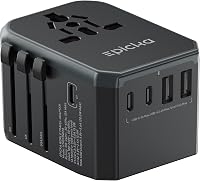
The EPICKA Universal Travel Adapter has plugs for multiple regions, an AC socket and USB charging ports. EPICKA states that it does not convert voltage and may not be suitable for high-power appliances such as hair dryers.
Use an adapter only when the appliance itself supports the destination's voltage and frequency. For a closer explanation of the difference, see travel adapter vs voltage converter.
Which product details matter for a hair dryer?
The main details are the dryer's label, the converter's wattage limit and any explicit appliance exclusions. Those details determine whether a product is a possible match; outlet count and USB charging features do not guarantee hair dryer compatibility.
| Product | What it does | Hair dryer guidance |
|---|---|---|
| FOVAL Power Step Down 220V to 110V | Converts voltage to 110V; 230W limit | FOVAL warns not to use it with hair dryers |
| EPICKA Universal Travel Adapter with 1AC/3 USB-C/2 | Changes plug shape and offers charging ports | EPICKA says it does not convert voltage |
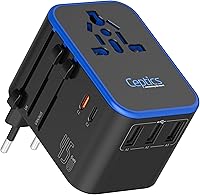
| BESTEK Universal Travel Adapter 220V to 110V | Converts voltage to 110V; 250W limit | BESTEK says it is not compatible with hair dryers |
The FOVAL and BESTEK models can convert voltage for certain compatible devices, but each has a direct hair dryer warning. The EPICKA adapter can charge supported electronics, but its plug options do not change the voltage supplied to its AC socket.
For another heat appliance, compare the separate advice on a travel voltage converter for a flat iron. Flat irons and hair dryers can have different power needs, so do not carry over compatibility assumptions from one to the other.
What should you pack if your dryer is incompatible?
If your dryer is incompatible, leave it at home and check whether your lodging provides one. You can also use a dryer designed for the destination's electrical system, following its instructions.
A dual-voltage dryer may avoid the need for a voltage converter, but you still need to confirm its label and use a plug adapter if needed. Don't assume a switchable setting is selected correctly; follow the dryer maker's directions before plugging it in.
If you plan to use another country's dryer, confirm its plug and power requirements before travel. For country-specific guidance, see our page about a travel voltage converter for Japan and our travel adapter for the Dominican Republic.
Which travel power gear should you choose?
Choose based on the device you're powering. For a hair dryer, use only a setup that its maker and the converter maker both approve; for phones and other charging devices, a travel adapter may be enough when their power supplies support the destination voltage.
The EPICKA adapter offers multiple plugs and USB charging ports, but it does not convert voltage. If you want portable charging capacity for devices that support the local supply, compare a best 20000mah power bank or best 10000mah power bank.
Before packing a hair dryer, confirm its voltage, frequency and wattage against the destination supply and the converter's instructions. If either maker excludes hair dryers, don't use that converter for the appliance.
Frequently asked questions
Can I use a travel voltage converter with my hair dryer?
Only if the converter's instructions explicitly support your dryer's voltage, frequency and wattage. Check both appliance and converter labels before use.
The FOVAL model here warns against hair dryers, and BESTEK says its converter is not compatible with them regardless of wattage.
Is a travel adapter the same as a voltage converter?
No. A travel adapter changes the plug shape to fit an outlet, while a voltage converter changes the supplied voltage.
Many universal adapters do not convert voltage, so check whether your hair dryer supports the destination's power before connecting it.
What should I check on a hair dryer label before travel?
Check the input voltage, frequency and wattage printed on the dryer or its cord. A dual-voltage label may show 100–240V and 50/60Hz, but confirm the travel instructions for that specific dryer and use a plug adapter if its plug does not fit.
Can the FOVAL converter power a hair dryer?
No. FOVAL states that its 230W step-down converter should not be used to supply power to a hair dryer.
Its 230W limit is below the needs of many dryers, so do not assume a converter is suitable from its voltage output alone.