How to Choose a 110V to 220V Travel Voltage Converter
Choose a converter by matching the destination voltage, appliance wattage and plug type. A 220V to 110V step-down converter suits American 110V appliances abroad, while a travel adapter only changes the plug shape.
On this page (8 sections)
- What does a travel voltage converter do?
- How do you choose the correct conversion direction?
- How should wattage guide your choice?
- Which appliances need special care?
- Which products fit different travel setups?
- How do plug types affect the setup?
- How do you set up a converter safely?
- What is the final choice rule?
The right travel adapter voltage converter from 110V to 220V depends on the direction of conversion, the appliance wattage and the outlet shape at your destination. Those three checks work together, and skipping one of them can leave you with a device that fits the plug but still runs at the wrong voltage.
If you are taking a U.S. 110V appliance to a 220V country, you usually need a 220V to 110V step-down converter, not a 110V to 220V step-up unit.
Step down means the converter lowers the incoming voltage for an appliance built for a lower supply. Step up means the opposite, and using the wrong direction will not help.
First, read the input label on every appliance. A label showing 100-240V, 50/60Hz usually means the device can accept common worldwide voltages, so it needs a plug adapter only.
That label is common on phone chargers, laptop chargers and many camera chargers.
A label showing 110V or 120V only needs conversion when the destination supplies a different voltage. A label showing 220V or 240V only needs the opposite direction if you bring it to a 110V supply.
The label matters more than the product name on the box. A device sold as a travel adapter may only change the plug shape, while a converter is built to change voltage as well.
Check the specifications before you pack rather than relying on the word travel alone.
Think about who each setup suits in daily use. A dual voltage charger is the simplest option because you only need the right plug shape.
A single voltage appliance needs conversion, a suitable watt rating and the correct plug for the wall.
For a broader overview of charging equipment, see our travel charger guide. If you want more converter options, compare our best travel voltage converter guide.
Set up your gear with the converter and adapter matched to both the destination and the appliance. That small check at home is easier than discovering a mismatch in a hotel room late in the evening.
Keep the appliance label photo on your phone as a backup. It helps when you are comparing a converter, a plug type and a watt limit without unpacking everything.
What does a travel voltage converter do?
A voltage converter changes electrical voltage, while a travel adapter changes only the plug shape. You need a converter for a single-voltage appliance when the outlet voltage does not match the appliance.
A U.S. appliance marked 110V or 120V can be damaged by direct connection to a 220V or 240V outlet. A step-down converter reduces the incoming voltage to a level intended for that appliance.
The reverse situation also matters. A device designed only for 220V may need a step-up converter when used with a 110V supply.
The direction is set by what the appliance needs and what the outlet provides.
Do not choose by the words “travel adapter” alone because many universal adapters do not convert voltage. A universal adapter can fit many outlet shapes and still leave the voltage unchanged.
That distinction affects daily use in a practical way. A phone charger marked 100-240V can usually work with a plug adapter only.
A single voltage hair tool may need conversion even if its plug fits an adapter.
Read our travel adapter vs voltage converter guide if you are unsure which function your device needs.
When a product combines both functions, check both parts separately. The voltage direction and watt rating tell you what the converter can do, and the plug types tell you where it can physically connect.
USB charging adds another layer to the decision. USB ports can charge phones and small devices, but they do not turn an adapter into a full voltage converter for an AC appliance.
Care also differs by function. A converter may need space for airflow and a clear surface, while a simple adapter is usually easier to pack and store.
The safest habit is to read the appliance label first, then match the product function to that label. That order prevents a good plug fit from hiding a voltage problem.
How do you choose the correct conversion direction?
Choose a 220V to 110V step-down converter when your appliance expects 110V and your destination supplies about 220V. This is the common choice for travelers taking some American hair tools, shavers or other single-voltage electronics overseas.
Choose a 110V to 220V step-up converter only when the appliance requires about 220V and the available supply is about 110V. The converter's input and output labels should match the direction you need.
Do not infer the direction from the country alone. Some destinations can have different voltage systems, and hotel outlets may include special sockets.
Check the destination voltage and the appliance label before packing. A quick check at home lets you choose the correct converter and plug combination for each device.
Direction also matters when you travel with more than one appliance. One device may be dual voltage and need only an adapter, while another may be single voltage and need conversion.
That mix is common in a packed bag. A laptop charger may work directly with a plug adapter, while a separate single voltage device may need the converter for the same trip.
Compare the input and output markings on the converter itself. The input should match the destination supply, and the output should match the appliance requirement.
Wattage sits alongside direction in the same decision. A converter with the right direction can still be wrong if its watt rating is too low for the appliance.
Do not assume that a converter bought for one appliance will suit every device in your bag. Each appliance label should be checked against the converter direction and limit.
For frequent travelers, a short packing list helps. Note the appliance voltage, the destination voltage, the plug type and the watt demand before you leave.
How should wattage guide your choice?
Choose a converter whose rated wattage is higher than the appliance's wattage. A lower watt rating can cause shutdown, overheating or an unsafe setup.
Check the appliance label for watts, volts and frequency. If the appliance lists amps instead of watts, multiply volts by amps to estimate its watt demand.
For motor-driven or heat-producing devices, leave more headroom and follow the converter's instructions.
USB ports do not replace an AC watt rating. A converter may charge several small devices while still being unsuitable for a high-power appliance.
The FOVAL Power Step Down 220V to 110V supplies 230 watts, with 2 AC outlets and 4 USB charging ports. Its stated use includes electronics such as electric shavers, electric toothbrushes, curling wands, laptops, fans, nebulizers and CPAP machines, while its warm-tip warning excludes hair dryers and electric heaters.
The FOVAL measures 4.82 x 3.13 x 1.47 in and has a 5 ft detachable power cable. Its title identifies it as a 220V to 110V converter for hair straighteners and curling irons, but the stated 230W limit still matters.
Check the appliance wattage before use.
Which appliances need special care?
Heat-producing appliances deserve the closest check because their watt demand can be high. Never connect a hair dryer, heater or similar appliance just because the plug fits.
The FOVAL specifically says not to use it for hair dryers or electric heaters. BESTEK also excludes hair dryers, coffee machines, steam irons, kettles and juicers, regardless of wattage.
Flat irons and curling irons still need label checks. Some support one voltage only, while others accept a voltage range.
Our guide to a travel voltage converter for flat iron covers that decision in more detail.
Laptop chargers, phone chargers and many camera chargers often show 100-240V, 50/60Hz. When that range appears on the charger, you generally need the correct plug shape rather than a voltage converter.
Motor driven appliances need care as well because startup demand can differ from the stated running demand. A fan, shaver or similar device should be checked against the converter limit and instructions.
High watt appliances can also stress a converter even when the plug shape matches. That is why an exclusion list matters as much as the headline watt rating.
Read the exclusion list before you rely on a converter for a heat or kitchen appliance. Some products exclude certain appliance types regardless of wattage, so a lower watt number does not make them suitable.
For hair tools, the label on the tool itself controls the choice. A dual voltage tool may need only a plug adapter, while a single voltage tool may need a converter within its watt limit.
Keep chargers separate from high demand appliances in your thinking. A charger marked for worldwide voltage is a different case from a heat producing appliance with a fixed voltage label.
Which products fit different travel setups?
The best choice depends on whether you need actual voltage conversion, plug coverage or several charging ports. Do not treat a universal adapter as a converter unless its specifications clearly state voltage conversion.
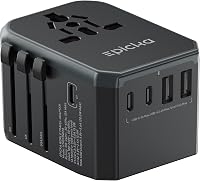
The EPICKA Universal Travel Adapter has 1 AC socket, 3 USB-C ports and 2 USB-A ports. It supports up to 6 devices at the same time, includes 4 plug types for more than 200 countries and regions, and is specifically not a voltage converter.
EPICKA's adapter measures 2.9 x 2.07 x 2.15 in and weighs 5.1 oz. Its USB-C ports are rated at 3A and its USB-A ports at 2.4A.
It includes a replaceable 10A fuse and 1 spare fuse, plus safety shutters and a plug lock system.
Its stated plug coverage includes Type C, Type G, Type I and Type A, while South Africa and India are excluded. The adapter's AC outlet does not convert voltage, so it is not the right choice for a single-voltage 110V appliance in a 220V country.
The BESTEK Universal Travel Adapter 220V to 110V is a 250W step-down converter with 3 AC outlets, 2 USB-A ports and 2 USB-C ports. Its USB-C ports support PD 20W charging, and the product supports up to 7 devices at the same time.
BESTEK measures 6.18 x 3.15 x 1.38 in and weighs 16 oz. It includes EU, UK, AU, US and India plug types, with Type C, Type G, Type A, Type I and Type D coverage.
BESTEK says the converter works with curling irons and straighteners but excludes hair dryers, coffee machines, steam irons, kettles and juicers. Its stated protections include over-current, overload, overheat and short-circuit protection.
How do plug types affect the setup?
A converter can change voltage without fitting the wall outlet, so you may need both a converter and a plug adapter. Some travel converters combine both functions, while a universal adapter may provide plug coverage without voltage conversion.
Match the plug type to the destination outlet. The EPICKA covers Type C, Type G, Type I and Type A, while BESTEK includes Type C, Type G, Type A, Type I and Type D.
FOVAL includes EU, US, UK and AU adapters and identifies Type C as its plug type.
For country-specific planning, see our best travel adapter for Italy guide. Japan also deserves a separate check because outlet style and appliance voltage may differ from what you use at home.
Read our guide to a travel voltage converter for Japan.
How do you set up a converter safely?
Set up the converter on a hard, open surface and keep its vents clear. Connect the converter to the outlet first, then connect the appliance after confirming the voltage direction and wattage.
Use only the plug adapter that matches the destination outlet. Keep the total connected load below the converter's stated watt limit, even when several small devices are connected.
Do not cover the converter with clothing or place it inside tightly packed luggage while powered. Unplug it when you leave the room, and allow it to cool before packing.
Fuse-based adapters need compatible replacement fuses. EPICKA includes one spare 10A fuse and explains that the fuse can cut power when total current exceeds 10A.
A power strip is a separate choice from a voltage converter. If you are taking several low-power chargers on a cruise, see our guide to a travel power strip for a cruise ship, then confirm the cruise line's current rules.
What is the final choice rule?
Pick a 220V to 110V converter when a single-voltage American appliance must run from a 220V supply. Choose FOVAL for a 230W setup with 2 AC outlets and 4 USB ports, or BESTEK for 250W, 3 AC outlets and 4 USB ports.
Pick EPICKA when you only need plug-shape conversion and multi-device charging for electronics that already accept the local voltage. For every option, match the conversion direction, wattage, plug type and appliance limits before connecting anything.
Start with the appliance label because it sets the voltage and watt requirements. Then match the destination supply, plug shape and any excluded appliance types.
That order suits most travelers and keeps the choice simple. A dual voltage charger needs an adapter, while a single voltage appliance needs the right converter direction.
Compare outlet and USB counts only after the voltage and watt checks pass. Extra ports help daily charging, but they do not fix a wrong direction or a watt limit that is too low.
For a converter setup, place it on a hard surface with vents clear and connect it before adding the appliance. Keep the total load within the stated limit and unplug it when you leave the room.
For an adapter only setup, confirm the plug types for your destination and keep spare charging cables ready. That setup suits phones, laptops and other electronics already marked for worldwide voltage.
The final rule is to match direction, wattage, plug type and appliance limits in that order. When those four points align, the setup is ready for the trip.
Frequently asked questions
Do I need a 110V to 220V converter or a step-down converter?
Most travelers from the United States need a 220V to 110V step-down converter when using a single-voltage American appliance in a 220V country. A 110V to 220V step-up converter is used in the opposite direction.
Check both the appliance label and the destination voltage before choosing.
Can a travel adapter convert 110V to 220V?
No. A travel adapter changes the plug shape so your charger or appliance can connect to a foreign outlet, but it does not change voltage.
Devices marked 100-240V, 50/60Hz usually need only the correct adapter, while single-voltage appliances need suitable voltage conversion.
How many watts should a travel voltage converter support?
Choose a converter with a watt rating above the appliance's stated wattage, then leave extra room for startup demand when the appliance needs it. A converter's USB count or outlet count does not show its total watt capacity.
Never exceed the converter's stated limit.
Can I use a voltage converter with a hair dryer?
Do not assume a converter works with a hair dryer. The products in this guide specifically exclude some high-power appliances, and hair dryers can draw substantial power.
Check the converter instructions and the hair dryer label before connecting them.