How to Choose a Travel Adapter with Surge Protection
Choose a travel adapter with surge protection only after checking your destination’s voltage and your devices’ input ratings. A plug adapter changes the plug shape; it does not convert voltage, and surge protection does not replace voltage compatibility.
On this page (8 sections)
- What should a travel adapter with surge protection do?
- How do voltage, current and surge protection differ?
- How do you check a device before plugging it in abroad?
- Does a universal travel adapter always protect against surges?
- What features matter when comparing adapters?
- Which destination details should you confirm?
- How should you use an adapter safely?
- How do you choose a travel adapter with surge protection?
Choose a travel adapter with surge protection only after checking your destination’s voltage and your devices’ input ratings. A plug adapter changes the plug shape, while surge protection addresses voltage spikes; neither function automatically converts the wall voltage.
Start by reading the input label on each device or its power supply. If it says 100–240V, it supports a broad voltage range; if it shows only one voltage, check the manufacturer’s guidance before plugging it in abroad.
Then confirm the outlet type, the adapter’s power limits and whether surge protection is explicitly included. For a broader overview of plugs and charging needs, see our travel charger buying guide.
What should a travel adapter with surge protection do?
A travel adapter with surge protection should fit the destination outlet, support your devices’ electrical requirements and state that surge protection is included. These are separate checks, so don’t assume that a universal plug shape guarantees electrical protection.
Surge protection is meant to respond to voltage spikes. It does not make incompatible voltage safe, and it does not turn a plug adapter into a voltage converter.
Check the adapter’s instructions for the countries and outlet types it supports. Then check the protection details, device limits and any conditions that affect use, such as fuse ratings or restrictions on high-power appliances.
How do voltage, current and surge protection differ?
Voltage, current and surge protection describe different electrical concerns. Match the device and adapter to the local supply and the device’s power needs before use.
| Check | What it tells you | What to verify |
|---|---|---|
| Voltage | The electrical potential supplied by the outlet | Local voltage and the device’s input range |
| Current and power | How much electrical load the device draws | Adapter limits and the device’s stated requirements |
| Surge protection | Whether the adapter includes protection against voltage spikes | The specific model’s stated protection features |
| Plug type | Whether the adapter fits the wall outlet | The destination’s outlet standard |
A fuse and surge protection are not interchangeable. A fuse is designed to interrupt power when current exceeds its rating; check the adapter instructions to understand what its particular fuse does.
A plug adapter also differs from a voltage converter. If a device does not support the local voltage, use an appropriate converter only when the device and converter instructions confirm the combination is suitable.
Our guide to a travel voltage converter for a hair dryer covers that appliance-specific decision.
How do you check a device before plugging it in abroad?
Read the input label on the device, charger or power supply, then compare it with the voltage where you’ll use it. A 100–240V input rating indicates support across that range, but you still need a compatible plug and an adapter with suitable limits.
Make a short list of everything you plan to power: phones, laptops, cameras and any appliances. Check labels rather than guessing from the device name or connector shape.
For each item, note:
- The voltage range printed on its label
- The power or current rating, if shown
- Whether it uses a separate power supply
- Any manufacturer restrictions on international use
If the label is unclear, check the device maker’s instructions before connecting it. Take extra care with heat-producing appliances, since a plug adapter may not convert voltage and may not be rated for their power draw.
Does a universal travel adapter always protect against surges?
No. “Universal” usually describes plug compatibility, not surge protection.
Verify the specific adapter’s stated features, because adapters with broad country coverage can have different protection and power capabilities.
For instance, the TESSAN European Travel Plug Adapter 2 Pack supports Type C outlets for many European destinations, but it states that it has no surge protection. It is therefore not a match if surge protection is a required feature.
Check your destination’s socket type before choosing any adapter, since some countries use more than one. For the UK, Ireland, Scotland and other Type G destinations, compare our best Type G travel plug adapter options.
What features matter when comparing adapters?
Compare destination coverage, voltage guidance, device limits and clearly stated protection features. Port count and size can help with convenience, but they do not show whether a model provides surge protection.
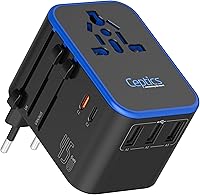
The Ceptics 45W Universal Travel Adapter includes an 8A fuse, safety shutters and a plug lock. Its stated features do not describe surge protection, so don’t treat the fuse as proof that it offers that function.
Ceptics says this adapter does not convert voltage and is not compatible with 110V-only hair dryers, curling irons or straighteners. Check your device’s input label before using it, even when the adapter fits the destination outlet.
The EPICKA Universal Travel Adapter with 1AC/3 USB-C/2 has a replaceable 10A fuse, safety shutters and a plug lock. For faster charging, compare fast-charging travel adapters and check their output against your devices.
Its stated features do not describe surge protection, and EPICKA says the adapter does not convert voltage.
EPICKA says the adapter may not suit high-power appliances such as hair dryers and curling irons. Its plug coverage excludes South Africa and India, so confirm both country coverage and device compatibility before packing it.
For a wider comparison of country coverage and charging features, use our best universal travel adapter guide. If saving bag space is a priority, see the best compact travel adapter options.
Which destination details should you confirm?
Confirm the outlet type and local voltage for every stop, including layovers where you may need to charge. A country name alone is not enough when regions or buildings can have different sockets.
Before departure, check an authoritative travel or electrical reference and the adapter’s instructions. Confirm that the adapter supports the destination’s plug type and that your devices support the local voltage.
If you’re traveling to Brazil, compare the outlet details in our best travel adapter for Brazil guide. For the travel adapter for the Dominican Republic, check the specific outlet and device requirements for your stay.
For Japan, remember that a plug adapter and a voltage converter serve different purposes. Our travel voltage converter for Japan guide can help you check whether a converter is relevant to your devices.
How should you use an adapter safely?
Follow the adapter’s instructions and stay within its stated voltage, current and power limits. Never force a plug into an outlet or use an adapter that is damaged, loose or unusually warm.
Use this checklist before connecting a device:
- Confirm the outlet type for your destination.
- Compare local voltage with the device’s input rating.
- Check the adapter’s stated power and current limits.
- Confirm surge protection is explicitly included if you require it.
- Follow the instructions for any fuse, grounding or high-power restrictions.
- Unplug the adapter if it shows damage, overheating or a loose connection.
Do not plug a high-power appliance into an adapter just because its prongs fit. Check both the appliance label and the adapter instructions, and use a suitable voltage converter only when the manufacturers’ guidance supports that setup.
How do you choose a travel adapter with surge protection?
Choose a travel adapter with surge protection by confirming surge protection is stated for that model, then matching its plug type, voltage guidance and power limits to your destination and devices. If any device’s voltage or power needs are unclear, check its manufacturer’s instructions before use.
Choose the adapter that fits your actual itinerary and charging load. A universal plug shape, built-in fuse or extra USB ports alone do not guarantee surge protection or voltage conversion.
Frequently asked questions
Does a travel adapter with surge protection convert voltage?
No. A plug adapter changes how your plug connects to a wall outlet, while a voltage converter changes the supplied voltage.
Surge protection is a separate feature.
Check your device label and adapter instructions, and use a suitable converter if your device cannot accept the local voltage.
How do I know if my device works with foreign voltage?
Read the input label on the device or its power supply. If it says 100–240V, it is designed for that voltage range; if it shows only one voltage, check the manufacturer’s guidance before using it abroad.
A travel adapter alone does not change voltage.
Do all universal travel adapters have surge protection?
No. Universal plug compatibility does not mean an adapter includes surge protection.
Check the specific model’s safety features and instructions.
For example, the TESSAN European Travel Plug Adapter 2 Pack states that it has no surge protection, so it does not meet that requirement.
Can I use a travel adapter with a hair dryer?
Only if the hair dryer supports the destination’s voltage and the adapter is rated for its power draw. Many travel plug adapters do not convert voltage, and some are not intended for high-power appliances.
Check the dryer label and the adapter’s instructions before connecting it.
Is a fuse the same as surge protection?
No. A fuse is designed to interrupt power when current exceeds its rating, while surge protection addresses voltage spikes.
One feature does not prove the other is present.
Check the adapter’s documented safety features and follow its instructions for the destination and devices you plan to use.