What Travel Adapter Do You Need for Mexico?
Most US devices do not need a plug adapter in Mexico, because Mexico commonly uses Type A and Type B outlets. Check your device label for 100-240V before plugging in anything that may need voltage conversion.
On this page (7 sections)
- Do you need a travel adapter in Mexico?
- Does Mexico use the same voltage as the United States?
- What should you check on a device before Mexico travel?
- Which travel adapters can help in Mexico?
- How do you choose between a Mexico adapter and a universal adapter?
- What should you pack for charging in Mexico?
- What travel adapter do you need for Mexico?
Most US devices do not need a plug adapter in Mexico because Mexico commonly uses Type A and Type B outlets, the same basic plug shapes used in the United States. You still need to check the voltage label on every device, because a plug adapter does not convert electricity.
That first check matters more than the plug shape for most modern electronics. A compact phone charger or laptop brick is often built for travel, but there is no safe way to guess that from the brand or the cable alone.
The label is usually printed in small text near the plug prongs or on the body of the charger. It will list an input range, and that range tells you whether the device is made to accept power in Mexico as well as at home.
For phones, cameras and laptops, look for an input range such as 100-240V, 50/60Hz. That wide range is a good sign that the device can handle the variation you may meet between countries.
If the label shows a much narrower range, pause before you plug anything in. A device built only for a single voltage needs a closer match, and a plug adapter on its own will not close that gap.
It also helps to separate small electronics from heating appliances in your packing plan. Phones, tablets, cameras and laptops usually fall into the low power group, while hair dryers and straighteners sit in a different category.
If you are comparing charging options for a longer trip, our travel charger guide explains how to match ports and power to your device load. That guide can help you plan which cables and chargers are worth carrying.
A simple routine at home works well before any trip. Check each label, sort devices by their voltage range, and decide what needs a converter rather than only a different plug connection.
You will then know whether Mexico is likely to be a plug and play stop for your US gear. That clarity should make the rest of the packing decisions much easier.
Do you need a travel adapter in Mexico?
Most travelers from the US can plug common chargers into Mexican outlets without an adapter. You may need one if your device has a different plug shape, has a grounded plug that does not fit the outlet, or if you want one unit to charge several devices.
For a single phone charger, that often means no adapter is needed at all. The device simply connects as it would at home, provided the outlet accepts its plug and the label shows a compatible input range.
Mexico uses Type A outlets with 2 flat pins and Type B outlets with 2 flat pins plus a grounding pin. US chargers with flat parallel pins usually fit, but outlet condition and room layout can vary.
A grounded plug needs a Type B outlet or an adapter that accepts a grounding pin. If you arrive to find only a two pin outlet in the room, you may need a different charger or a suitable adapter.
Some hotel rooms place outlets in less convenient spots than you expect. An adapter can also act as a small spacer, which sometimes helps when a charger body blocks a second socket.
A universal adapter is still useful if your trip includes other countries before or after Mexico. It can also combine one AC socket with several USB ports, reducing the number of separate charging blocks in your bag.
That combined design suits travelers who carry a phone, a tablet, a camera and a laptop at the same time. Instead of searching for several wall sockets, you can use one connection point for a handful of devices.
It also suits couples or friends who share a room and a limited number of outlets. One adapter with several USB ports can keep the charging area tidy and reduce the chance of cables spreading across the floor.
There is a trade off in size and weight, because a universal unit is usually larger than a simple plug. For a Mexico only trip with standard US chargers, carrying no adapter or a very basic one may be the lighter choice.
Think about the full route rather than the first hotel alone. If later stops use different plug shapes, a universal adapter bought for Mexico can still earn its place in the bag.
Does Mexico use the same voltage as the United States?
Mexico and the United States use similar household voltage ranges, but you should still read the label on each device. Voltage compatibility comes from the device, not from the adapter.
Similar does not always mean identical for every device. That is why the input range printed on the charger matters more than general advice about a destination.
A phone charger or laptop power brick marked 100-240V is designed for worldwide voltage ranges. A device marked only 110V, 120V or another single voltage may not be suitable for every outlet or electrical system.
Frequency is part of the same label, and it is shown as 50Hz, 60Hz or a combined range. Most modern chargers accept a wide range, but you should follow the guidance printed for your own device.
Do not assume that a travel adapter protects a single-voltage appliance. Hair dryers, curling irons and straighteners draw more power than small chargers and deserve extra attention.
High power appliances also react differently when the supply does not match their design. A plug adapter may fit the socket perfectly while still leaving the appliance at risk.
Many travelers carry a dual voltage hair dryer for exactly this reason. If yours is not dual voltage, the safer plan is often to leave it at home and use a hotel provided option.
For general electrical safety guidance, review Electrical Safety First's plug and socket guide. The key rule remains simple: confirm the device input range before connecting it.
That habit protects your devices and also protects you from a disappointing first night in a new place. A few seconds reading the label can save a charger, an appliance or a whole charging plan.
It is worth checking devices you rarely use at home as well as your everyday phone charger. Older accessories, spare cables and backup chargers can have different labels from the ones you use daily.
What should you check on a device before Mexico travel?
Read the small print on the charger, power brick or appliance. Find the input line and look for the voltage range, frequency and any wattage limit.
That small print is not decoration, and it is usually the fastest way to make a safe decision. It tells you what the device was designed to accept, regardless of what plug it has.
- 100-240V: Usually suitable for international travel with the correct plug connection.
- 110-120V only: Check that the destination outlet and device rating match.
- 240V only: Not suitable for a typical US or Mexico connection without the correct electrical equipment.
- 50/60Hz: A wide frequency range gives more flexibility, but follow the device instructions.
- High wattage: Treat heating appliances with more caution than phone and laptop chargers.
Wattage deserves a separate glance for anything that heats up. A high wattage appliance puts more demand on the connection, so mismatched voltage becomes a bigger problem.
A USB charger does not automatically make every connected device safe. The charger manages power for its USB outputs, while an AC socket passes power through to the connected appliance.
That distinction matters when you use a hub with both USB ports and an AC outlet. Your phone may charge safely through a USB port while a separate appliance plugged into the AC socket still needs its own voltage check.
Look at the cable and the device at the other end as well. A USB cable on its own does not set the voltage, because the charger and the device decide how power is handled.
If a label is worn or hard to read, treat that device with extra care. Losing the original charger can also mean losing the clearest source of information about its input range.
It helps to photograph the labels at home before you travel. You can then check them quickly in a hotel room without hunting for fine print in poor light.
For laptops, check the power brick rather than only the laptop itself. The brick carries the detailed input information you need for international use.
Which travel adapters can help in Mexico?
These 3 options solve different travel problems. The first is the most flexible for mixed international trips, while the second is focused on European Type C connections and the third combines several worldwide plug types with multiple USB ports.
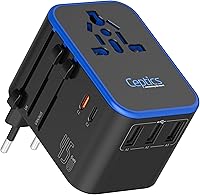
Ceptics 45W Universal Travel Adapter
The Ceptics 45W Universal Travel Adapter suits travelers who want one compact unit for Mexico and other countries. It has 1 universal input, 3 USB-A ports and 2 USB-C ports, including 1 USB-C port with power delivery and Quick Charge 3.0, with 45W total charging output.
Its plug coverage includes Type A for the United States, Canada, Mexico and Japan, plus Type C, Type G and Type I connections for other destinations. That makes it more useful for a multi-country itinerary than a Mexico-only plug solution.
Ceptics identifies this adapter as not a voltage converter. It is not suitable for 110V-only hair dryers, curling irons or straighteners when the electrical supply does not match the appliance.
The built-in safety system includes an 8A fuse, an extra fuse, safety shutters and a plug lock. Those features add protection around the connection, but they do not replace checking the voltage and wattage printed on your device.
TESSAN European Travel Plug Adapter 2 Pack
The TESSAN European Travel Plug Adapter 2 Pack suits travelers who need Type C connections for Europe, not as a direct Mexico choice. It includes 4 AC outlets, 2 USB-A ports and 1 USB-C port with up to 15W USB-C output.
The adapter is designed for European countries such as Spain, France, Italy, Germany and Switzerland. Type C does not cover the United Kingdom, Ireland or Scotland, so check every country on your route before relying on it.
TESSAN describes it as a plug adapter only, not a voltage converter. Its stated power range is 100V to 250V, with maximum total power of 2500W at 250V and 1000W at 100V.
Its compact size is 2.24 x 3.14 x 2.65 in, and the listed weight is 3.48 oz. Those details make the 2-pack convenient for splitting between bags, but the Type C design is not the natural match for a US-to-Mexico trip.
EPICKA Universal Travel Adapter with 1AC/3 USB-C/2
The EPICKA Universal Travel Adapter with 1AC/3 USB-C/2 USB-A Ports suits travelers who need one adapter for several plug systems. It includes Type A, Type C, Type G and Type I plugs, covering more than 200 countries and regions according to EPICKA, excluding South Africa and India.
Its 6-in-1 layout has 1 AC socket, 3 USB-C ports and 2 USB-A ports. EPICKA says the adapter can charge up to 6 devices at once, including phones, laptops, tablets, power banks, cameras and headsets.
This adapter does not convert voltage. EPICKA lists maximum power of 1100W at 110V and 2400W at 240V, but you still need to compare those limits with the appliance you intend to connect.
A replaceable 10A fuse and 1 spare fuse are included. The adapter also has safety shutters and a plug lock, while the package includes the adapter and 1 user manual.
How do you choose between a Mexico adapter and a universal adapter?
Choose based on your whole itinerary, not only the Mexico stop. A US traveler visiting Mexico alone may need no adapter, while a traveler visiting several regions may benefit from universal plug coverage.
Use this quick rule:
- Choose no adapter if your US chargers fit the outlet and their labels show compatible voltage.
- Choose a universal adapter if your trip includes Europe, the United Kingdom, Australia, China or other plug systems.
- Choose more USB ports if several people will charge devices at the same time.
- Choose a smaller unit if you only need to charge a phone and watch.
- Avoid relying on an adapter for a single-voltage heating appliance.
If you are comparing broader options, see our guide to the best universal travel adapters. For a smaller packing setup, the best compact travel adapters may be a better match.
What should you pack for charging in Mexico?
Pack the charger that came with each device, plus a short cable for each port type you use. A small power strip or multi-port charger can help in a room with limited outlets, but confirm that its voltage rating fits the destination and your devices.
Keep high-power appliances separate from your phone and laptop charging plan. A universal adapter with multiple USB ports can charge small electronics, but it does not turn a 110V-only hair dryer into a worldwide appliance.
If Mexico is part of a longer international route, check the plug type for every later stop. Our guides to travel adapters for Spain, travel adapters for Switzerland, and travel adapters for China cover destinations where the connection may differ.
Travelers heading to the Caribbean can also compare the travel adapter for the Dominican Republic before packing one adapter for the full itinerary.
What travel adapter do you need for Mexico?
The right travel adapter for Mexico is often no adapter at all for standard US plugs, provided your chargers fit the outlet and accept the local voltage. Pick the Ceptics model for broad plug coverage and several USB ports, the TESSAN pack for European Type C stops, or the EPICKA model for a multi-region itinerary.
Each option answers a different kind of trip. A Mexico only stay with US chargers may need nothing extra, while a route that moves between regions asks for wider plug coverage.
The Ceptics 45W Universal Travel Adapter suits travelers who want several USB ports in one compact unit. It offers a universal input with 3 USB-A ports and 2 USB-C ports, including 1 USB-C port with power delivery and Quick Charge 3.0 for 45W total charging output.
Its plug coverage includes Type A for the United States, Canada, Mexico and Japan, plus Type C, Type G and Type I for other destinations. That breadth makes it a practical choice when Mexico is one stop on a longer international route.
The TESSAN European Travel Plug Adapter 2 Pack is a different kind of purchase. It is aimed at European Type C connections, with 4 AC outlets, 2 USB-A ports and 1 USB-C port, rather than at a direct US to Mexico connection.
The EPICKA Universal Travel Adapter with 1AC/3 USB-C/2 USB-A Ports suits travelers who need several plug systems in one unit. It includes Type A, Type C, Type G and Type I plugs, covering more than 200 countries and regions according to EPICKA, excluding South Africa and India.
Its 6-in-1 layout provides 1 AC socket, 3 USB-C ports and 2 USB-A ports for charging up to 6 devices at once. That setup can suit a family or a group sharing a room, where one central charging point is easier to manage.
None of these adapters converts voltage, and that limit should shape your final choice. Check every device label for a suitable input range before you rely on any adapter for travel.
Always check the device label before use. A plug adapter changes the connection shape, while a voltage converter changes electrical output.
Those are different jobs.
Frequently asked questions
Do US plugs work in Mexico?
US Type A and Type B plugs generally fit Mexico's common outlets, so many US travelers do not need a plug adapter. Check the outlet at your hotel and inspect each device's voltage label before use, especially for appliances with heating elements.
Do I need a voltage converter in Mexico?
You usually do not need a voltage converter for a device marked 100-240V, 50/60Hz. A device marked only 110V or 120V needs closer checking before use, because a plug adapter changes the shape of a connection but does not change voltage.
What travel adapter works in Mexico?
A Type A or Type B connection works for many US devices in Mexico, while a universal adapter can help if you are carrying plugs from other countries. Choose an adapter with enough USB ports for your devices, and confirm that it is not being sold as a voltage converter.
Can I use a hair dryer in Mexico?
Check the hair dryer's voltage label before using it in Mexico. A dual-voltage appliance marked 100-240V may work with the correct plug connection, but a single-voltage appliance needs a suitable converter or should be left at home.