What Travel Adapter Do You Need for Japan?
Most US travelers need a Type A or Type B plug adapter for Japan, but many US devices need no plug adapter at all. Check your device label for 100–240V before packing, because a plug adapter changes the plug shape, not the voltage.
On this page (6 sections)
The travel adapter you need for Japan depends on two separate checks: plug shape and voltage compatibility. A US phone charger may fit a Japanese outlet directly, while a single-voltage appliance may need a converter even if its plug fits.
A plug adapter only changes the shape of the connection so the plug can reach the outlet. A converter changes the voltage supplied to the device, which is a different job entirely.
Japan generally uses flat-pin Type A and Type B outlets. Type A is the ungrounded flat pin style, and Type B adds a ground pin for larger plugs.
The safest approach is to inspect the plug on every device, then read its input label for voltage and frequency. Do this at home while you still have time to pack an alternative, rather than in a hotel room after a long flight.
Start with the devices you actually use each day. A phone charger, a laptop charger and a camera charger may each have different labels, even if they look similar.
It also helps to separate low power chargers from heating appliances. Chargers for phones and laptops often accept a wide voltage range, while appliances that produce heat tend to demand more careful checks on voltage and wattage.
A travel charger can reduce the number of separate wall chargers in your bag. One unit with several USB ports may replace multiple plugs, which makes packing and setting up in a small hotel room much simpler.
For more regional comparisons, see our guide to the best travel plug adapter for Asia. Regional guides are useful when Japan is part of a longer route, because the plugs and voltage rules can change at the next stop.
Trip length matters too. A short stay with one phone may need very little gear, while a longer trip with several devices often benefits from extra ports.
Keep the goal simple from the start. Confirm the plug shape, confirm the voltage range, and only then decide whether an adapter, a converter, or neither is needed for that device.
What travel adapter do I need for Japan from the USA?
Most US visitors should pack a Type A-compatible travel plug adapter, especially if their chargers have grounded or bulky plugs. Some simple two-flat-pin US plugs may fit Japanese outlets without an adapter, but a dedicated adapter can provide a more secure connection and extra charging ports.
Japan's voltage is lower than the US standard. That means the plug may fit while the device still needs voltage compatibility.
Look for these markings on the charger or appliance:
100–240V, 50/60Hz: usually suitable for Japan without a voltage converter.110–120V: check the device instructions before use.- A single voltage such as
220–240V: not suitable for Japan without the correct conversion equipment. - A wattage rating: compare it with the converter's supported wattage.
Phone, tablet, laptop and camera chargers often have a wide input range, but you must check the label on your own device. Do not assume every appliance uses the same voltage range.
What is the difference between a Japan travel plug adapter and a converter?
A travel plug adapter for Japan changes the physical plug connection. It does not change the electricity's voltage.
A voltage converter changes voltage for devices that require it. This matters most for heating appliances and other high-power equipment, such as hair straighteners, curling irons and some electric shavers.
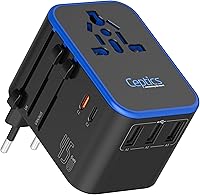
The EPICKA Universal Travel Adapter is a plug adapter with charging ports, not a voltage converter:
Its four plug types cover USA, Canada, Japan, the UK, Ireland, Scotland, France, Germany, Italy, Spain, China, Australia, Argentina and New Zealand, among other regions. It excludes South Africa and India.
The adapter has 2 USB-A ports rated at 2.4A and 3 USB-C ports rated at 3A. It can charge up to 6 devices at once through the AC socket and USB ports.
EPICKA states that the adapter does not convert voltage and may not suit high-power appliances such as hair dryers, curling irons or straighteners. Its maximum power is 1100W at 110V and 2400W at 240V.
Can you use a US plug in Japan?
You may be able to use a simple US two-flat-pin plug in Japan, but compatibility depends on the plug, outlet and device voltage rating. A grounded plug or a bulky charger may need an adapter even when a basic US plug fits.
The third pin often makes the difference. A simple two-pin plug may slide into a Japanese outlet, while a larger grounded plug may not fit the same opening.
Size and grip also matter. A bulky charger can sit loosely or block nearby outlets even when its pins enter the socket.
A compact adapter can give a firmer connection and add extra ports.
Before leaving, check:
- The device's plug shape.
- The voltage range printed on the charger.
- The device's wattage if it is an appliance.
- Whether you need several outlets or USB ports.
- Whether the adapter covers the Japanese plug style.
Write the results down for each device. A short list on your phone makes the final packing decision clearer.
For plug shape, compare the pins with Type A and Type B outlets. If your plug has a ground pin, choose an adapter that supports grounded connections rather than forcing a loose fit.
For voltage, look for a range such as 100 to 240V. That wide range usually means the device can handle Japan's lower voltage without conversion, provided the plug connection also works.
If the label shows a single narrow range, pause before packing. The device may need a converter, or it may be better left at home if a local alternative is available.
For wattage, check appliances more closely than small chargers. Heating appliances draw more power, so their labels matter when you decide whether a converter is suitable.
For ports, count how many devices you hope to charge at once. Extra USB ports can reduce waiting when you carry a phone, tablet and earbuds together.
For coverage, confirm that the adapter lists Japan or Type A and Type B support. A universal adapter may cover many countries, but you still need the specific plug style for your outlets.
A universal adapter can help if Japan is one stop on a longer trip. It still cannot convert voltage unless the product specifically includes conversion hardware.
That limit affects what goes into your bag. A plug adapter solves a shape problem, while a converter solves a voltage problem, and one product does not automatically do both jobs.
Consider your daily routine before you choose. If you charge devices overnight in one place, a multi-port adapter may suit you well.
If you move between trains and sightseeing stops, portable power may matter more.
Keep adapters dry, avoid forcing plugs into outlets, and stop using a device that feels unusually hot or shows damage.
When do you need a step-down converter in Japan?
You need a step-down converter when your device requires a higher voltage than Japan supplies, or when the device is not rated for the available voltage. Match the converter to the device's voltage and wattage before connecting it.
The FOVAL Power Step Down 220V to 110V is designed to step down voltage to 110V for compatible electronics:
FOVAL describes it as stepping down 220V to 110V and supporting equipment such as hair straighteners, curling irons, electric toothbrushes, CPAP machines, electric shavers, laptops and fans. Its stated limit is 230W, so it is not intended for hair dryers or electric heaters.
That 230W limit is the most important number to respect. It means the converter suits lower power appliances within that range, while higher demand heating devices fall outside its intended use.
Check the wattage on the appliance label before you pack it.
The unit measures 4.82 x 3.13 x 1.47 in and includes a 5 ft detachable power cable. It has 2 AC outlets and 4 USB ports, with USB output listed as 5V and 8.4A total.
The compact size helps it fit in a packed bag, although it is still larger than a simple plug adapter. The detachable cable allows some setup flexibility, so you can position the converter where it is easier to keep clear and ventilated.
The two AC outlets and four USB ports suit travelers who carry more than one device. That layout can reduce the need to unplug and swap devices, but it does not raise the total power limit for connected appliances.
It includes an EU power cable and international adapters for US, UK and Australia connections. FOVAL describes those adapters as covering outlet types A, C, I and G across more than 150 countries, including Japan.
That wider plug coverage can help when Japan is part of a multi-country route. Still, the adapters handle plug shape, while the converter handles voltage, and both need to match the device you plan to use.
For daily use, set the converter on a flat, dry surface with space around it. Avoid covering it with clothes or packing it tightly into a bag while it is running, since airflow helps it operate within its stated protection limits.
Its protection features include automatic shutdown for surge, overheating, short circuit, over-current, over-temperature and overload conditions. Those features are a safeguard, not a reason to ignore the wattage limit or to connect unsuitable appliances.
Treat the 230W limit as a firm boundary and check your appliance label before use. If the label is hard to read or the wattage is missing, it is safer to choose a different device or a local alternative for the trip.
What should you pack for charging phones in Japan?
For phones and other USB devices, pack a charger that accepts Japan's power and a cable that matches your devices. A power bank gives you a way to recharge away from an outlet, but it does not replace a wall adapter.
The BLAVOR Solar Power Bank has a 10,000mAh capacity and supports USB-C input and output:
It supports USB-C output up to 20W, 10W wireless charging and charging up to 3 devices simultaneously. Compatible devices include iPhone, iPad, AirPods, Samsung, Google and Android phones, Nintendo Switch, mini fans and most USB charging mobile devices.
That mix of wired and wireless charging suits a travel day with several small devices. A phone can charge wirelessly while earbuds or a tablet use a cable, as long as you keep total demand realistic for a portable battery.
The 20W USB-C output can refill a phone faster than a basic low power output. It still remains a portable option rather than a full wall charger.
The power bank measures 5.9 x 3.1 x 0.8 in and weighs 9.3 oz. Its outer case uses flame-retardant ABS and PC materials, with waterproof silicone protection.
Those dimensions make it easy to carry in a jacket pocket or a small day bag. It is slim enough for daily sightseeing, although you will notice it if your bag is already full.
BLAVOR lists IPX5 water resistance, dust resistance and shock resistance. It also includes dual flashlights, a compass carabiner, built-in cables and a user manual.
Water and shock resistance offer practical protection outdoors, but they do not make the power bank invincible. Keep it dry where possible and avoid drops on hard surfaces.
The built-in cables reduce the need to carry separate leads for common devices. That can cut clutter and lower the risk of leaving a cable behind.
The dual flashlights and compass carabiner add utility beyond charging. They may help on a dark trail, during a power outage, or while sorting gear.
The solar panel is best treated as an emergency backup. Its maximum solar charging current is 0.23A, with maximum power of 1.15W, so cable charging is the practical primary method.
That low solar output means sunlight is a slow way to refill the battery. It may help when no outlet is available, but it should not be your main plan for charging multiple devices each day.
For best results, charge the power bank by cable before a long day out. Then use solar input as a small top-up rather than relying on it to restore a depleted battery quickly.
Keep the solar panel clean, avoid leaving the unit in extreme heat, and check the charge level before you set out.
How do you choose a travel plug adapter for Japan?
Choose based on your devices and your trip length, not on the number of countries shown on the package.
A long list of countries can look impressive, yet it may not match the devices in your bag. Start with what you carry, how often you charge it, and whether you need wall power or portable power during the day.
For a short Japan trip with a phone and laptop, a small Type A-compatible adapter may be enough. If you carry several USB devices, the EPICKA adds 3 USB-C ports, 2 USB-A ports and 1 AC socket.
That port layout suits travelers who charge a phone, tablet and earbuds in the same place. It can reduce cable clutter at a hotel desk, while still leaving an AC socket for a laptop charger.
If you plan to use a compatible appliance that needs voltage reduction, the FOVAL offers 230W step-down conversion. Check the appliance wattage first, and do not use it for a hair dryer or electric heater.
The appliance decision should come before the adapter decision. Read the voltage and wattage label, confirm the converter limit, and only then pack the appliance if it fits both requirements.
If you expect long days away from outlets, the BLAVOR adds a 10,000mAh battery, wireless charging and built-in cables. Its solar function is a backup rather than the main charging method.
That option suits sightseeing days, train travel and outdoor stops where wall outlets are not easy to reach. It gives you a way to top up a phone away from the hotel, even if solar charging itself remains slow.
Size and weight also deserve a place in the choice. A compact adapter is easier to carry daily, while a multi-port adapter or power bank adds bulk that may be worth it for a longer trip.
Think about how you charge at night as well. If several devices need power at once, a multi-port wall setup may be more convenient than relying on one battery for every charge.
For trips that include other destinations, compare regional options such as a Type D travel adapter, a travel adapter for Thailand or a travel adapter for Vietnam. A travel adapter for Mexico may also be useful for a separate North American itinerary.
Regional comparisons help when your route crosses borders. Check each stop in turn, because a plug that works in one country may not work in the next.
The best choice usually leaves little waste in your bag. It covers the plugs you need, respects the voltage limits of your devices, and leaves room for cables and daily essentials.
What should you check before using an adapter in Japan?
Check the device label before plugging it in, even when the plug fits. Confirm the voltage range, frequency, wattage and the adapter's own limits.
That check should happen before you leave home, while you can still swap a device or add a converter. A wide voltage range gives you more flexibility than a label limited to one voltage.
Keep the adapter dry, avoid covering ventilation openings on a converter and stop using any device that shows heat, damage or unusual behavior. Replace a fuse only with the correct type when the adapter is designed for replacement.
Dry storage matters because moisture can damage electrical equipment and create a safety risk. A small pouch or case in your bag can protect adapters and cables from splashes, dust and pressure.
Ventilation matters for converters that run warm during use. Leave space around the unit, place it on a stable surface, and avoid tucking it under bedding or inside a closed cabinet while it is connected.
If a fuse is part of the design, use only the correct replacement type listed for that adapter. A fuse is a safety device, so the wrong size or type can prevent it from protecting the equipment as intended.
A compact adapter is easier to pack, while a multi-port adapter can reduce cable clutter. For charging-focused trips, you can also compare the best EPICKA travel adapter and best Anker international travel charger.
The comparison should focus on ports, plug coverage and voltage limits rather than marketing claims alone. Ask how many devices you charge at once, whether you need an AC socket, and whether any appliance requires conversion.
For charging-focused trips, portable power can sit alongside wall charging rather than replacing it. A power bank helps during the day, while a wall adapter handles overnight charging for devices that need a steady connection.
Make a final review on the night before departure. Check each charger label again, confirm the adapter covers the Japanese plug style, and remove anything that exceeds a converter limit or duplicates a cable you do not need.
The right choice is simple: use a plug adapter when the connection needs it, use no converter for devices marked 100–240V, and choose a properly rated step-down converter for appliances that require it. Do not confuse a travel plug adapter for Japan with a voltage converter.
That clear split keeps the packing decision calm and practical. Match the plug shape first, respect the voltage label second, and let your actual devices guide the final bag.
If any device feels unusually hot, makes unusual sounds, or shows visible damage, stop using it and choose another option.
Frequently asked questions
What travel adapter do I need for Japan from the USA?
Most US travelers should look for a Type A or Type B plug connection for Japan. Many US chargers already use compatible flat pins, but a compact travel adapter can add USB charging ports.
Check each device label for 100–240V, 50/60Hz before connecting it.
Does Japan use the same plugs as the USA?
Japan and the USA both use flat-pin plug styles, so some US plugs fit Japanese outlets without an adapter. Japanese power is commonly 100V, however, so check voltage compatibility even when the plug fits.
A plug fit alone does not confirm safe operation.
Do I need a voltage converter for Japan?
You need a voltage converter only when a device is not compatible with Japan's 100V supply and its rated voltage differs from the power available. Phones, laptops and camera chargers often show 100–240V.
A plug adapter alone does not convert voltage.
Can I use a US hair dryer in Japan?
Check the hair dryer's voltage and wattage label before travel. A single-voltage US hair dryer may need a voltage converter, while a dual-voltage model can work when set correctly.
The converter must also support the appliance's wattage, so avoid using a converter above its stated limit.