9 Best Anker Power Banks for Travel (November 2026)
The best Anker travel power banks include the Anker Laptop Power Bank for extended laptop trips, the Anker Power Bank for most phone trips, and the Anker Zolo Power Bank for longer phone trips.
On this page (7 sections)
The best Anker travel power bank for most phone trips is the Anker Power Bank 10,000mAh 30W. It balances a compact body, built-in USB-C cable and enough capacity for common day travel, while larger Anker models make more sense for laptops, tablets and long stretches away from outlets.
Capacity is only one part of the choice. Output, cable type, port count, body thickness and wireless charging can matter more when you're moving through airports or packing a small day bag.
For cruise cabin outlets, compare a cruise ship power strip.
For a broader overview, start with our travel charger buying guide. If your priority is keeping the power bank thin, compare these picks with the best slim power banks.
Our picks at a glance
-
1
-
2

-
3

The best Anker travel power bank picks
The best Anker travel power bank depends on the devices you carry. The picks below are ordered by score, with the highest scores going to models that cover the widest travel needs.
We compared the stated capacity, output, ports, cables, size, weight and charging features. Our score weighs specs, features and buyer feedback against what you're shopping for.
| Product | Best for | Capacity | Output | Weight | Our score |
|---|---|---|---|---|---|
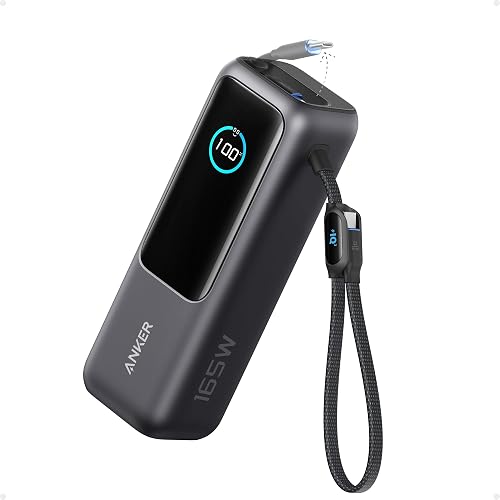
| Anker Laptop Power Bank | extended laptop trips | 25,000mAh | 165W total | 300g | 9.7 |
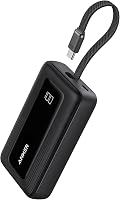
| Anker Power Bank | most phone trips | 10,000mAh | 30W | 223g | 9.6 |
| Anker Zolo Power Bank | longer phone trips | 20,000mAh | 30W | 365g | 9.3 |
| Anker Power Bank | a slim travel pouch | 10,000mAh | 8.48oz | 9.3 | |
| Anker MagGo Power Bank | iPhone wireless charging | 10,000mAh | 9.3 | ||
| Anker Nano Power Bank | a pocket-sized top-up | 5,000mAh | 22.5W | 3.5oz | 8.9 |
| Anker Nano Power Bank | fast phone top-ups | 10,000mAh | 45W maximum | 231g | 8.6 |
| Anker Prime Power Bank | laptop and tablet balance | 27,650mAh | 250W total | 1.5lb | 8.5 |
| Anker Prime Power Bank | maximum charging output | 26,250mAh | 300W total | 600g | 8.4 |
Anker Laptop Power Bank: Best for extended laptop trips
- 25,000mAh capacity
- 165W total output
- Three 100W USB-C ports
- Two built-in cables
Three 100W USB-C ports, two built-in cables and 25,000mAh capacity make this the strongest fit for travelers carrying a laptop and several devices.
Pros
- Three 100W USB-C ports
- Two built-in cables
- 25,000mAh capacity
Cons
- Larger than the 10,000mAh picks
- Charger is not included
The Anker Laptop Power Bank is the strongest choice for a work trip with a laptop, tablet and phone. Its 25,000mAh capacity and 165W total output give it more room for several devices than the 10,000mAh models.
Three USB-C ports can each provide up to 100W, and the unit also has a USB-A port. The two built-in cables reduce the number of loose cables in your bag, with one retractable cable extending up to 2.3 ft and another 0.98 ft cable that doubles as a carrying strap.
The 300g body measures 6.18 x 2.13 x 1.93 inches. It is listed at 90Wh and complies with 100Wh airline restrictions, but you should still confirm your airline's carry-on rules before flying.
This is a better fit for extended work travel than a slim phone bank. The trade-off is a larger body, and the charger shown with the product is not included.
Anker Power Bank: Best for most phone trips
- 10,000mAh capacity
- 30W output
- Built-in USB-C cable
- 4.32 x 2.58 x 0.98 inches
This compact 10,000mAh model offers 30W two-way charging and a built-in USB-C cable for everyday phone travel.
Pros
- Compact dimensions
- Built-in USB-C cable
- 30W output
Cons
- The built-in cable is USB-C
- Less capacity than the 20,000mAh and larger models
The Anker Power Bank is the easiest all-around pick for phone travel. Its 10,000mAh capacity, 30W output and 4.32 x 2.58 x 0.98-inch size suit a day bag without taking much room.
It suits travelers who want one compact unit that can stay in a jacket pocket or small tote. The shape is also easier to pack beside a phone than a taller, laptop-focused bank.
A 5.4-inch built-in USB-C cable handles compatible USB-C devices, while USB-C and USB-A ports add flexibility. The cable is designed to withstand more than 10,000 bends.
That built-in cable saves space, but it does not suit every phone. Older iPhone models will still need their own Lightning cable through one of the other ports.
The model supports up to 30W output and 20W input. An iPhone 15 can receive up to 2 full charges according to the stated device estimates, while AirPods Pro 2 can receive up to 10 charges.
Those estimates make it a practical choice for a day out or a short trip. You should still expect some energy loss during conversion, so the printed capacity is not a literal charge count.
Choose this one when your main need is a compact phone charger with its own cable. For more 10,000mAh comparisons, see our best compact power bank 10000mah guide.
Anker Zolo Power Bank: Best for longer phone trips
- 20,000mAh capacity
- 30W two-way charging
- Built-in USB-C cable
- Low-current charging mode
The 20,000mAh capacity suits extended days away from outlets, while the built-in USB-C cable keeps the charging setup simple.
Pros
- 20,000mAh capacity
- Built-in USB-C cable
- Low-current charging mode
Cons
- Heavier than the 10,000mAh choices
- USB-C cable does not suit every phone without another cable
The Anker Zolo Power Bank is the better choice when 10,000mAh is not enough for your itinerary. Its 20,000mAh capacity gives it more stored energy for long travel days, while 30W two-way charging keeps the output useful for phones and other compatible devices.
The built-in USB-C cable measures 5.98 inches and is designed to withstand more than 10,000 bends. The body measures 4.72 x 2.89 x 1.24 inches, and the listed weight is 365g.
A low-current charging mode supports small devices such as earphones. The model also supports pass-through charging up to 5V/3A, although simultaneous charging and discharging is not supported for laptops.
Pick it for longer phone travel when extra weight is acceptable. Its 20,000mAh capacity also makes airline checks more important, so read our guide on whether you can bring a 20,000mAh power bank on a plane.
Anker Power Bank: Best for a slim travel pouch

- 10,000mAh capacity
- 0.61-inch thickness
- USB-C input and output
- USB-C to USB-C cable included
Its 0.61-inch thickness and 10,000mAh capacity make it a practical choice when your power bank must fit a slim pouch.
Pros
- Very slim design
- USB-C input and output
- USB-A and USB-C ports
Cons
- Longer body than some compact models
- 30W output is not stated
The Anker Power Bank, 10,000mAh Portable Charger is the best slim option in this group. Its body is 0.61 inches thick, and the listed weight is 8.48oz.
That thickness is the main reason to pick it. It can slide into a narrow pouch or side pocket where a chunkier 10,000mAh bank would feel bulkier.
The USB-C port handles both input and output, while a USB-A port gives you another connection option. A USB-C to USB-C cable is included, so the setup suits phones and other USB-C devices.
Because the cable is separate, you must remember to pack it. The trade-off is flexibility, since you can swap in a different cable for a different device when needed.
An iPhone 15 can receive up to 2 charges in the stated estimate, while a Galaxy S23 can receive up to 1.93 charges. The model also has scratch resistance in its design and is certified by a 3.2 ft drop test.
Those details suit everyday travel where the bank may sit loose in a bag. Keep it in its pouch when possible to protect the slim body and ports.
Choose this one when thickness matters more than built-in cable convenience. It is also a good match for travelers who already carry a USB-C cable and want a simple 10,000mAh backup.
Anker MagGo Power Bank: Best for iPhone wireless charging

- 10,000mAh capacity
- 15W Qi2 wireless charging
- 30W USB-C output
- Metal frame and matte finish
The MagGo combines a slim 10,000mAh body with 15W Qi2 magnetic charging for compatible iPhone models and 30W USB-C output.
Pros
- 15W Qi2 wireless charging
- 0.56-inch stated thickness
- 30W USB-C output
Cons
- Designed for iPhone
- Wireless charging can slow with thick cases
The Anker MagGo Power Bank is the best Anker travel power bank here for compatible iPhone wireless charging. It combines a 10,000mAh capacity with a 15W maximum Qi2 charging pad and a 30W USB-C port.
That mix suits iPhone users who want to avoid a cable for a quick top-up. You can still use the USB-C port when you want a wired connection or need to charge another device.
The body measures 4.09 x 2.78 x 0.56 inches, making it one of the thinnest choices here. Its matte finish, metal frame and aerogel thermal insulation give it a different design from the cable-first models.
The slim shape works well in a small bag, but it is still a 10,000mAh bank rather than a laptop-grade unit. It is aimed at phone travel, not sustained charging for larger devices.
It is designed for iPhone 12 through iPhone 16 series devices. Anker does not recommend it for Android phones because fit and alignment can affect placement or charging speed.
It can provide up to 1.8 charges for an iPhone 15 Pro in the stated estimate. That makes it a useful day-trip option when you want magnetic convenience.
Wireless charging can slow when a phone has a thick case or is warm. For a wired alternative, compare the best power bank 10000mah type c options.
Anker Nano Power Bank: Best for a pocket-sized top-up

- 5,000mAh capacity
- 22.5W output
- Foldable USB-C connector
- Two USB-C ports
This small 5,000mAh model is aimed at short outings and phone top-ups, with a foldable USB-C connector and two USB-C ports.
Pros
- Small capacity for light carry
- Foldable USB-C connector
- 22.5W output
Cons
- Least capacity here
- Connector fit is limited by thick phone cases
The Anker Nano Power Bank is the smallest-capacity pick and the best fit for a short outing. Its 5,000mAh battery, 22.5W output and foldable USB-C connector are aimed at light phone carry.
It suits a short walk, a commute or a day when you only need a backup top-up. The idea is to carry less, not to cover several days away from an outlet.
The connector folds into the body, while a second USB-C port supports charging and recharging with a cable. The product data gives a 3.5oz weight for a pocket or purse-friendly setup.
Folding the connector keeps the profile tidy when packed. You should still hold the phone and bank together while charging, as the foldable design calls for a steadier grip.
It is designed for iPhone 15 and iPhone 16 series devices, along with listed Samsung Galaxy models. The connector fits phone cases up to 4.9mm thick, so thicker protective cases can prevent a good connection.
That case limit is worth checking before you travel. A thick case may force you to use the second port and a separate cable instead.
Choose it for emergency top-ups rather than multi-day travel. Its effective capacity is lower than the nominal 5,000mAh because energy is lost during conversion.
Anker Nano Power Bank: Best for fast phone top-ups

- 10,000mAh capacity
- 45W maximum output
- Retractable USB-C cable
- Smart display
A retractable USB-C cable, smart display and 45W maximum output make this a strong phone-focused option for travelers who value quick top-ups.
Pros
- 45W maximum output
- Retractable cable
- Smart display
Cons
- Not recommended for sustained laptop charging
- Multiple-port output is limited
The Anker Nano Power Bank is for travelers who want a compact 10,000mAh bank with higher stated output. It offers 45W maximum output, a smart display and a retractable USB-C cable.
It suits phone-focused trips where a quick top-up matters more than laptop charging. The display can also help you see what the bank is doing at a glance.
The body measures 3.21 x 1.99 x 1.42 inches, and the listed weight is 231g. Its cable is designed for more than 20,000 bends, which keeps the charging connection attached to the unit when packed.
A retractable cable reduces the chance of leaving the main charging cable behind. It also keeps the setup neater in a day bag than a loose cable loop.
The USB-C port provides up to 45W output, while input reaches 30W. The model is not recommended for sustained laptop charging, so its strongest use is quick phone top-ups.
Heat can also slow charging as a device warms up. That is normal for high-output charging and does not mean the stated maximum will hold for an entire session.
When two ports are used, maximum output drops to 15W, and three-port use limits each port to 7.5W. Choose it if the retractable cable and display matter more than maximum multi-device output.
Anker Prime Power Bank: Best for laptop and tablet balance

- 27,650mAh capacity
- 250W total output
- Three ports
- 99.54Wh airline-compliant capacity
The Prime offers high capacity, three ports and up to 140W laptop output for travelers carrying a laptop, tablet and phone.
Pros
- 250W total output
- Three ports
- Travel pouch included
Cons
- Heaviest option here
- Needs dual chargers for its fastest recharge
The Anker Prime Power Bank is a strong middle ground for travelers carrying a laptop and smaller devices. Its 27,650mAh capacity, 250W total output and three ports give it more flexibility than phone-only banks.
It suits work trips where a laptop, tablet and phone all need power during the same day. The extra capacity is useful when outlets are limited in airports or transit.
It can provide up to 140W to a laptop while charging a tablet and phone. The ports are two USB-C connections and one USB-A connection, and the listed weight is 1.5lb.
That weight is the clear trade-off. It is easier to justify when your laptop needs the higher output than when you only carry a phone.
The capacity is 99.54Wh, which meets the stated under-100Wh TSA requirement for carry-on travel. You should still check your airline rules before flying, since carrier policies can vary.
The unit can fully recharge in 37 minutes with 170W total input using dual chargers. That fast recharge needs the right dual-charger setup, so it is less simple than recharging a smaller bank.
Its larger body measures 6.37 x 2.24 x 1.96 inches. It is best for demanding travel days, while a 10,000mAh model is easier to carry when you only need phone power.
Anker Prime Power Bank: Best for maximum charging output

- 26,250mAh capacity
- 300W total output
- 140W maximum output
- 250W dual-port input
This Prime model is for demanding multi-device loads, with 300W total output, 140W maximum output and 250W dual-port input.
Pros
- Highest total output here
- 140W maximum output
- 240W cable included
Cons
- Heaviest model here
- High output is more than most phone-only trips need
The Anker Prime Power Bank, 26,250mAh 300W is the output-focused choice. It provides 300W total output, up to 140W from one connection and 250W dual-port input for fast replenishment.
It suits travelers carrying demanding devices who want the highest output in this group. That includes people who may need to power two high-power laptops at the same time.
Its three ports include two USB-C ports and one USB-A port. The included USB-C to USB-C cable is rated at 240W, which helps avoid using a lower-rated cable when high output matters.
Using the included cable is important for high-power charging. A lower-rated cable can limit the speed even when the bank itself can supply more.
The 26,250mAh capacity is listed as 99.75Wh and TSA-approved. The unit weighs 600g and measures 6.3 x 2.5 x 1.5 inches, so the performance comes with a clear carry weight.
That weight makes it a deliberate packing choice rather than a casual backup. It is best placed in a larger bag where the extra room is available.
Choose this model for two high-power laptops or other demanding loads. For a phone-only itinerary, its output and weight are more than you need.
How much capacity do you need for travel?
A 10,000mAh Anker power bank is enough for many day trips, while 20,000mAh suits longer days and 25,000mAh or more makes more sense for laptops. Usable energy is lower than the printed capacity because charging loses energy during conversion.
The Anker Zolo 20,000mAh model gives an example of this trade-off. Its stated usable output is about 11,000mAh to 14,000mAh after normal energy loss, so the printed number should not be treated as a direct count of phone charges.
For a lightweight day bag, compare our guide to the best 10,000mah power bank options. If your priority is reducing carried weight, our best lightweight power bank for travel guide covers the practical trade-offs.
What output do phones, tablets and laptops need?
Phones usually need less output than laptops, so a 30W Anker model is enough for many phone-focused trips. Laptop travelers should look at the available USB-C output, the total output across ports and the cable rating.
Output is a maximum, not a constant speed. A phone will only draw the power it is designed to accept, and charging usually slows as the battery fills up.
That is why a 45W phone-focused bank does not make a phone charge at 45W for the whole session. Heat can also cause the device or bank to reduce power to protect the battery.
Tablets sit between phones and laptops in most travel setups. They may benefit from a higher-output model, but the cable and the device limit still decide the real speed.
The 10,000mAh Anker Power Bank provides up to 30W output. The Nano model provides up to 45W, but its own information says it is not recommended for sustained laptop charging.
That limit matters because laptop batteries are larger than phone batteries. A bank may show a slow percentage rise on a laptop even while it is working at high output.
The Laptop Power Bank provides three 100W USB-C ports and 165W total output. The Prime models go further, but their larger bodies make sense only when your devices can use that power.
When you share ports, the total output is shared as well. Check how the bank behaves with two or three devices connected before you rely on it for a full workday.
For a phone-only trip, a 30W model with a built-in cable is often the simpler choice. For a laptop trip, compare single-port output, total output, cable rating and weight together.
Built-in cable or separate cable?
A built-in cable reduces loose items, while a separate cable gives you more flexibility if your devices use different connectors. Check your phone and tablet ports before choosing a cable-first model.
Built-in cables are convenient when your main device uses USB-C. You can pack the bank without hunting for the right cable in a tangled pouch.
The trade-off is that the built-in cable cannot be swapped easily. If your phone uses a different connector, you will still need to carry another cable.
The Anker Power Bank 10,000mAh 30W and both Zolo models include built-in USB-C cables. The Nano 10,000mAh model adds a retractable cable, while the slim PowerCore model includes a separate USB-C to USB-C cable.
A retractable cable is a middle option between fixed and fully separate. It stays attached to the bank, but it can extend when you need more reach.
The MagGo uses wireless charging for compatible iPhones, but it also has a USB-C port. A separate cable may still be useful for devices that do not align with the charging pad.
Wireless charging can also be slower or less reliable with thick cases. A cable gives you a more direct connection when alignment is difficult.
Before you buy, list every device you will carry and its connector type. That short check will tell you whether a built-in cable is enough or whether a separate cable is still required.
How should you pack and use an Anker power bank?
Keep a power bank in your carry-on bag, protect its ports and avoid charging it in a hot, poorly ventilated place. A small power bank case for travel can help keep cables and the bank together.
A case or pouch also helps when the bank shares a bag with keys or other hard items. Keeping the ports covered reduces the chance of damage during transit.
Heat can reduce charging speed. The MagGo information notes that thick cases and phone use while charging can increase heat, while the Prime information recommends a cool, well-ventilated place during charging.
Avoid leaving a bank in a hot car or in direct sun while it charges. A cooler spot can help the bank and your device charge more steadily.
Recharge the bank before a travel day and carry the cable that matches your devices. If you use multiple ports, expect the available output to be shared or limited.
That sharing matters most when a laptop is connected. A phone may charge more slowly when the bank is also supplying a larger device.
Store the bank in a cool, dry place when you are not using it. Keeping it away from extreme heat is a simple habit that suits long-term travel use.
More guides on this topic
- Best Fast-Charging 10,000mAh Power Banks
Which Anker travel power bank should you choose?
Choose the Anker Power Bank 10,000mAh 30W for most phone trips, the Anker Laptop Power Bank for a laptop-heavy itinerary, and the Anker Zolo Power Bank 20,000mAh when you need longer phone coverage.
The 10,000mAh 30W model is the simplest starting point for a day bag. It has a compact body, a built-in USB-C cable and enough capacity for common phone top-ups.
The Laptop Power Bank is the better fit when a laptop is part of your daily carry. Its three 100W USB-C ports and 165W total output suit travelers who charge several devices away from outlets.
The Zolo 20,000mAh model makes sense when a 10,000mAh bank would not last the trip. The extra capacity comes with extra weight, so it suits longer days more than light outings.
Pick the Anker MagGo Power Bank for compatible iPhone wireless charging, the slim Power Bank for a thin pouch, and the Nano 5,000mAh model for a light emergency backup. The Prime models are for travelers who can justify more weight for laptop and multi-device output.
The MagGo is the clearest pick for magnetic iPhone charging. The slim Power Bank is better when thickness matters, and the Nano 5,000mAh model is for short outings rather than multi-day travel.
The Prime models should be chosen for their output, not just their capacity. They are easier to justify when a laptop or several larger devices need power during the day.
Before flying, check your carrier's current rules and keep the bank in your carry-on. For another airline-focused check, read can you bring a portable charger on a plane.
Our top 3 picks at a glance
-
1
-
2
-
3
Frequently asked questions
What is the best Anker travel power bank for most people?
The Anker Power Bank 10,000mAh 30W is the best fit for most phone-focused trips. It has a compact 4.32 x 2.58 x 0.98-inch body, a built-in USB-C cable and 30W output.
Choose a 20,000mAh model for longer days away from outlets or a larger Prime model for laptop charging.
Is a 20,000mAh Anker power bank allowed on a plane?
The Anker Zolo Power Bank has a 20,000mAh capacity and is designed for extended travel, but airline rules can vary by carrier and route.
Keep power banks in carry-on baggage and check your airline's current requirements before flying. See our guide to bringing a 20,000mAh power bank on a plane for the key checks.
Is an Anker 10,000mAh power bank enough for travel?
An Anker 10,000mAh power bank is enough for many day trips and phone top-ups. The 30W model lists up to 2 full charges for an iPhone 15, while the MagGo lists up to 1.8 charges for an iPhone 15 Pro.
Actual results vary with the phone, cable, charging speed and energy lost during conversion.
Which Anker power bank is best for a laptop?
The Anker Laptop Power Bank is the strongest laptop-focused pick here because it has 25,000mAh capacity, three 100W USB-C ports and 165W total output.
The Anker Prime models also target laptop travel, with 140W maximum output on the 27,650mAh model and 300W total output on the 26,250mAh model.