International Flight Carry-On Luggage Rules
International carry-on rules vary by airline and flight segment, so check the size, weight, and item limits for every carrier on your itinerary. For connections, plan around the strictest allowance and confirm whether your bag must fit a sizer.
On this page (8 sections)
- What are the carry-on luggage rules for international flights?
- How should you plan carry-on luggage for connecting international flights?
- How do you measure a carry-on bag correctly?
- How do international carry-on weight limits work?
- What counts as a personal item on an international flight?
- How can you choose a suitcase for an international trip?
- What should you check before going to the airport?
- What happens if your carry-on doesn't meet the rules?
International flight carry-on luggage rules depend on the airline operating each flight, with different limits for bag size, weight, and personal items. Check every segment of your trip, measure your packed bag including wheels and handles, and plan around the strictest allowance.
A suitcase described as a carry-on may still exceed one airline's cabin limit. On a connecting trip, the carrier for your next flight may have a smaller allowance, even if your first flight accepted the bag.
What are the carry-on luggage rules for international flights?
There is no single carry-on size or weight rule for all international flights. Each airline sets its own limits, and some vary them by route, aircraft, ticket, or fare.
Check the policy of the airline operating the flight, not just the airline that sold the ticket. A flight number can be marketed by one airline and operated by another, so look for the operating-carrier details in your itinerary.
Review the permitted cabin bag dimensions, weight limit if one applies, and rules for a personal item. Confirm whether the allowance covers handles and wheels, and whether the airline measures the bag by its exterior dimensions.
For a broad overview of carrier differences, see what the carry-on rules for airlines are. Then confirm the current rules directly with each airline before you pack.
How should you plan carry-on luggage for connecting international flights?
Use the strictest carry-on allowance across all your flight segments. This helps you avoid repacking, gate-checking, or paying a fee if a later carrier has tighter limits.
Write down the allowance for each operating airline before choosing a bag. Include the dimensions, weight, personal-item allowance, and any conditions that apply to your fare or route.
If you have separate tickets, check both airlines' policies and leave extra time between flights. A checked bag may not transfer automatically between bookings, and a carry-on that fits the first flight may still be too large for the next one.
What if one airline allows a larger bag than another?
Pack to the smaller allowance if you want to keep the same bag in the cabin throughout the trip. If you pack to the larger carrier's limit, be ready for the smaller carrier to require a different arrangement.
You can compare your bag's outside measurements with what size carry-on luggage you can take on a plane. Measure the packed suitcase rather than relying only on its advertised size.
How do you measure a carry-on bag correctly?
Measure the bag from its outermost points, including wheels and handles. Compare those total dimensions with the airline's stated limit, and check whether it lists the order as height, width, and depth.
Measure the case standing upright, with its handle fully retracted. Include fixed wheels, side handles, and bulging pockets; don't assume a brand's “carry-on” label matches every airline's sizer.
A soft bag can be easier to press into a sizer, but only if it fits without forcing it. Keep external pockets from bulging beyond the allowed dimensions.
Does expanding a suitcase change its size?
Yes, expansion can make a carry-on too deep for the airline's limit. Measure it in the expanded state if you plan to use that extra space during the flight.
A hard-sided case may look compact when empty, yet become deeper when expanded or packed tightly. Keep the expansion closed when the airline's limit is close, and remeasure after packing.
How do international carry-on weight limits work?
Weight limits depend on the airline and route, so check whether your carrier sets one. If it does, confirm whether the stated weight applies to the cabin bag alone or includes another item.
Weigh your packed bag with the personal items you plan to carry inside. A suitcase's empty weight uses part of any allowance, so leave room for a laptop, toiletries, and items added at the airport.
Don't treat a published allowance as guaranteed boarding space. Airlines may also limit cabin baggage based on overhead bin capacity or aircraft type, and staff may ask you to check a bag at the gate.
What counts as a personal item on an international flight?
A personal item is a separate small bag allowed in addition to a cabin suitcase when the airline's fare and rules include one. Its size and placement rules vary, so check whether it must fit under the seat in front of you.
Common examples include a small backpack, purse, or laptop bag, but the airline defines what qualifies. Some low-cost fares include only one small item, while others permit both a cabin bag and a personal item.
Measure a personal item when it's packed, since a full backpack can be bulkier than it appears. If you want a smaller option, compare underseat carry-on luggage and check its packed dimensions against your airline's personal-item allowance.
How can you choose a suitcase for an international trip?
Choose a suitcase whose packed dimensions and weight fit the tightest airline rules on your itinerary. A lighter bag also leaves more of a weight allowance for the items you need to carry.
For a starting point, the Samsonite Omni PC has overall dimensions of 22 x 15 x 9.5 in and weighs 6.81 lb. Its expansion can add capacity, so keep it closed if that would exceed your carrier's limit.
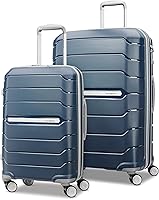
The Samsonite Freeform measures 15 x 10 x 23 in with wheels and is described as meeting most airlines' cabin size restrictions. Airlines set their own rules, so compare these dimensions with each carrier on your route.
The Amazon Basics 21-inch case measures 14.8 x 10 x 21.7 in including wheels. Its expansion can provide up to 25% more space, so measure it again if you plan to expand it.
For more options to compare, see our guide to the best carry-on luggage for international travel. If a Delta flight is part of your itinerary, check carry-on luggage for Delta flights alongside the rules of any connecting carrier.
What should you check before going to the airport?
Confirm the latest cabin baggage policy for each operating carrier shortly before departure. Check your fare, route, and aircraft details, since these can affect the allowance.
Use this checklist:
- Identify the operating airline for each flight.
- Check its cabin bag size and weight limits.
- Check whether your fare includes a cabin bag and personal item.
- Measure your packed bags, including wheels and handles.
- Weigh the cabin bag if the airline sets a limit.
- Keep expansion closed if it pushes the bag over the limit.
Save the policy or take a screenshot so you can review it while packing. If the airline's page is unclear, contact the carrier before travel and keep the response with your trip details.
What happens if your carry-on doesn't meet the rules?
The airline may ask you to repack, check the bag, or pay a fee, depending on its policy and the situation. A bag that fits one flight can still be rejected on a later segment.
If you discover a mismatch before leaving, move heavy or bulky items to a compliant checked bag where possible. At the airport, follow the operating airline's instructions and keep medication, documents, valuables, and essential items with you when allowed.
For international connections, the safest planning rule is simple: choose a bag that fits the smallest size limit and the lowest weight allowance across the itinerary. Recheck those limits before departure, especially when your booking includes more than one carrier.
Frequently asked questions
Do international flights have a standard carry-on size?
No, international flights don't share one universal carry-on size or weight limit. Each airline sets its own cabin baggage policy, and limits can vary by route, ticket, aircraft, or fare.
Check the operating carrier's current rules for every flight segment and include wheels, handles, and pockets when measuring.
Do I need to follow the rules of every airline on a connecting trip?
Yes, check each operating airline on your itinerary, especially when you change carriers or have separate tickets. A bag accepted on the first flight may exceed a later carrier's limit.
If the rules differ, use the tightest size and weight allowance as your packing target.
Are carry-on weight limits checked on international flights?
Some airlines set a cabin bag weight limit and may weigh bags at check-in or the gate; others focus on size or impose different limits by route and fare. Check the airline's policy before departure, then weigh your packed bag if a limit applies.
Does an expandable suitcase still count as a carry-on?
It can, if its packed dimensions stay within the airline's allowance. Expansion adds depth, so measure the bag after expanding and packing it.
Include wheels, handles, and any external pockets, and compare the total with the operating airline's limit for that flight.